
Listen to this article
Periodic Table Basics Study Guide
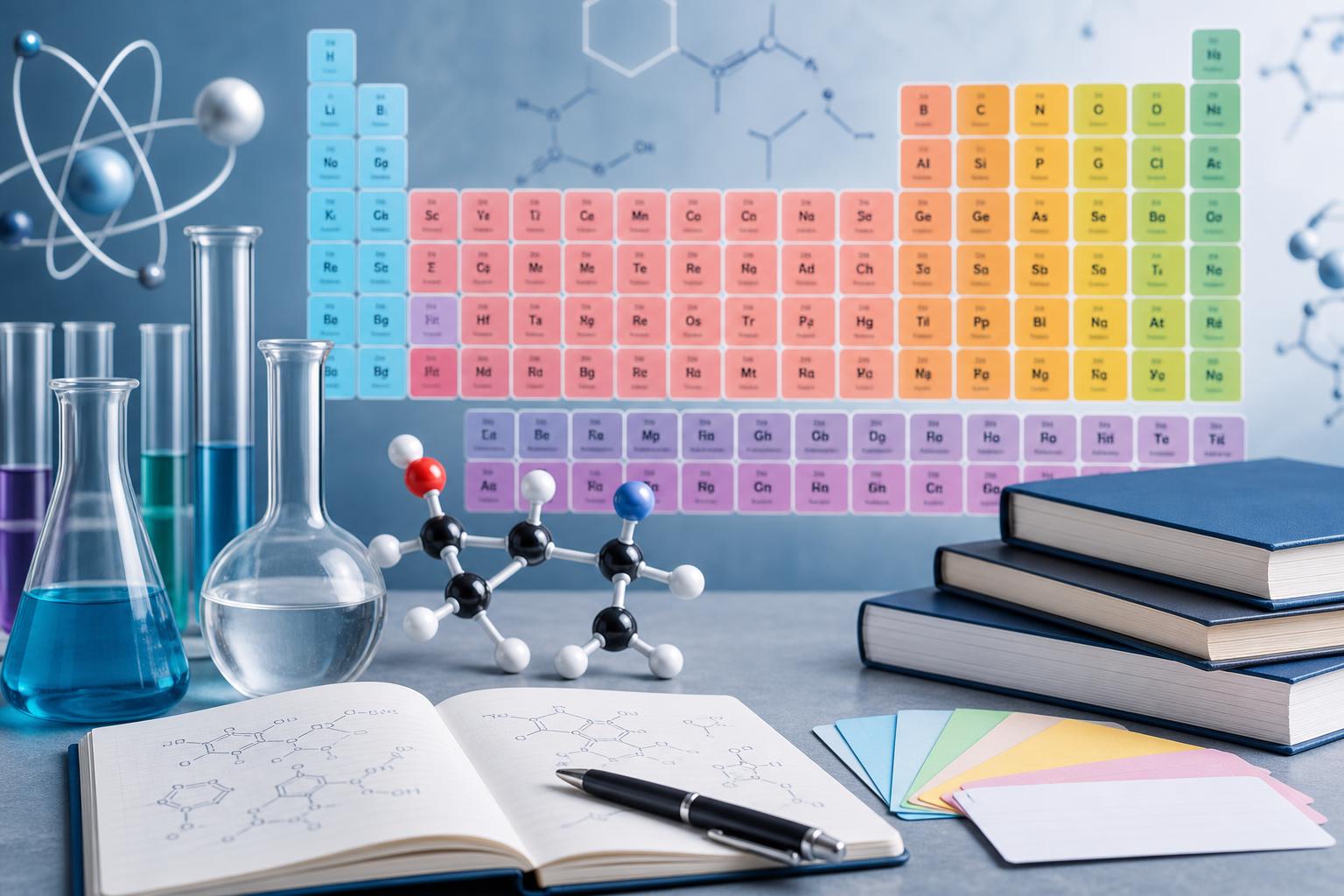
This periodic table basics study guide explains how the periodic table is organized, what element symbols and atomic numbers mean, and how groups, periods, metals, nonmetals, and metalloids help predict chemical behavior. Use it as a general chemistry review to understand trends such as atomic radius, ionization energy, electronegativity, and reactivity before practicing with flashcards and a quiz.
Key takeaways
- The periodic table arranges elements by increasing atomic number, which equals the number of protons in an atom.
- Elements in the same group, or column, often have similar chemical properties because they have the same number of valence electrons.
- Periods are rows that show increasing atomic number and changing properties from left to right.
- Metals are mostly on the left and center, nonmetals are mostly on the upper right, and metalloids border the staircase line.
- Periodic trends help predict properties such as atomic radius, ionization energy, electronegativity, and reactivity.
What the Periodic Table Shows
The periodic table is a chart of all known chemical elements arranged by atomic number. Each element box usually includes the element symbol, element name, atomic number, and average atomic mass. The atomic number is the number of protons in the nucleus and identifies the element. For example, carbon has atomic number 6, so every carbon atom has 6 protons. The atomic mass is related to the average mass of naturally occurring isotopes of that element.
Groups, Periods, and Valence Electrons
A group is a vertical column on the periodic table. Elements in the same group often react in similar ways because they have similar valence electron arrangements. Valence electrons are the outermost electrons and are important in bonding. A period is a horizontal row. As you move across a period, the number of protons increases and electrons are added to energy levels, causing predictable changes in properties.
Major Element Categories
Elements are commonly classified as metals, nonmetals, and metalloids. Metals are usually shiny, conductive, malleable, and tend to lose electrons to form positive ions. Nonmetals are often poor conductors and tend to gain or share electrons. Metalloids, such as silicon and boron, have properties between metals and nonmetals. The periodic table also includes important families such as alkali metals, alkaline earth metals, halogens, noble gases, and transition metals.
Important Periodic Trends
Periodic trends describe patterns in element properties. Atomic radius generally decreases from left to right across a period and increases down a group. Ionization energy, the energy needed to remove an electron, generally increases across a period and decreases down a group. Electronegativity, an atom’s ability to attract shared electrons, generally increases across a period and decreases down a group. These trends help explain bonding, reactivity, and compound formation.
How to Study Periodic Table Basics
Start by learning what each part of an element box means, then memorize the locations of major groups such as alkali metals, halogens, and noble gases. Practice reading atomic number and atomic mass, identifying element categories, and comparing trends. Good periodic table notes should connect position to behavior: where an element is located tells you about its likely charge, bonding patterns, and reactivity.
Flashcards
What does the atomic number of an element represent?
The atomic number represents the number of protons in the nucleus of an atom.
What are groups on the periodic table?
Groups are vertical columns of elements that often have similar chemical properties.
What are periods on the periodic table?
Periods are horizontal rows of elements arranged by increasing atomic number.
Why do elements in the same group often behave similarly?
They often have the same number of valence electrons, which affects bonding and reactivity.
Where are metals generally located on the periodic table?
Metals are generally located on the left side and in the center of the periodic table.
Where are nonmetals generally located on the periodic table?
Nonmetals are generally located on the upper right side of the periodic table.
What are noble gases known for?
Noble gases are known for being very unreactive because they have full outer electron shells.
What is electronegativity?
Electronegativity is an atom’s ability to attract shared electrons in a chemical bond.
How does atomic radius generally change across a period from left to right?
Atomic radius generally decreases from left to right across a period.
What are metalloids?
Metalloids are elements with properties between metals and nonmetals.
Quiz
1. What is the periodic table primarily organized by?
- A. Increasing atomic number
- B. Increasing density
- C. Alphabetical order
- D. Decreasing atomic mass
Show answer
Answer: Increasing atomic number
The modern periodic table is arranged by increasing atomic number, which is the number of protons in an atom.
2. Which particles determine an element’s atomic number?
- A. Protons
- B. Neutrons
- C. Electrons in bonds
- D. Valence electrons only
Show answer
Answer: Protons
Atomic number equals the number of protons in the nucleus, and that number identifies the element.
3. Elements in the same group usually have similar properties because they have similar numbers of what?
- A. Valence electrons
- B. Neutrons
- C. Isotopes
- D. Nuclei
Show answer
Answer: Valence electrons
Valence electrons control many bonding and reactivity patterns, so elements in the same group often behave similarly.
4. Which family of elements is known for being very unreactive?
- A. Noble gases
- B. Alkali metals
- C. Halogens
- D. Transition metals
Show answer
Answer: Noble gases
Noble gases have full outer electron shells, making them stable and generally unreactive.
5. What generally happens to atomic radius as you move down a group?
- A. It increases
- B. It decreases
- C. It becomes zero
- D. It stays exactly the same
Show answer
Answer: It increases
Atomic radius generally increases down a group because atoms gain additional energy levels.
6. Which description best fits metals?
- A. Good conductors that often lose electrons
- B. Poor conductors that often gain electrons
- C. Unreactive gases with full outer shells
- D. Elements only found in Group 18
Show answer
Answer: Good conductors that often lose electrons
Metals are usually conductive, malleable, and tend to lose electrons to form positive ions.
FAQs
What are the basics I should know about the periodic table?
You should know that the periodic table is arranged by atomic number, that groups are columns with similar properties, that periods are rows, and that an element’s position helps predict its bonding, reactivity, and trends.
How do I read an element box on the periodic table?
Most element boxes show the atomic number, chemical symbol, element name, and atomic mass. The atomic number tells you the number of protons, while the atomic mass is the average mass of the element’s naturally occurring isotopes.
What is the easiest way to memorize periodic table trends?
Focus on the direction of each trend. Atomic radius increases down and to the left. Ionization energy and electronegativity generally increase up and to the right, with noble gases often treated as exceptions for electronegativity.
Next step
Turn this topic into a study session with notes, flashcards, and a practice quiz built from your own class material.
Related guides
- Chemical bonding study guide
- Elasticity of demand study guide
- Accounting basics study guide
- How to take better notes from online classes and recorded lectures
- How to turn recorded lectures into notes with AI
- How to turn a recorded lecture into notes
- How to turn a lecture recording into notes
- How to record and transcribe lectures

Leave a Reply