Listen to this article
Best Way to Study From a Lecture Transcript: Summary, Flashcards, and Quiz Workflow
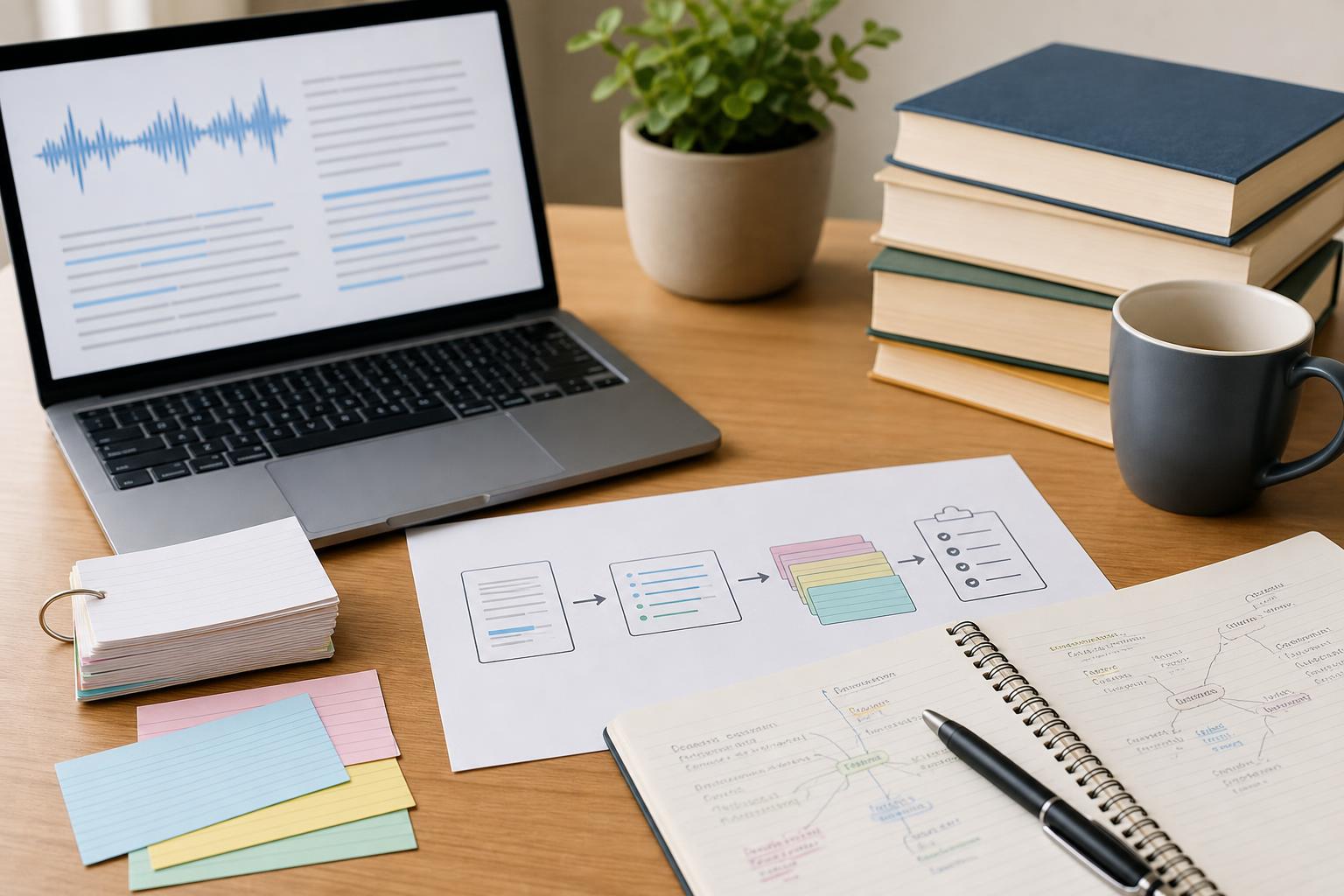
The best way to study from a lecture transcript is to treat it as raw material, not as something to reread from top to bottom. Start by cleaning and organizing the transcript, then create a short summary, convert key ideas into flashcards, and finish with a quiz that forces recall. This workflow turns a long lecture recording or transcript into a focused study session: understand the main ideas, memorize the details that matter, and test whether you can use the information without looking. Tools like AI Study Assistant can automate much of the transcript-to-study-material process, but the strongest results come when you review, edit, and actively practice with the generated notes, flashcards, and quizzes.
Key takeaways
- Do not study a transcript by rereading it passively; convert it into active learning materials.
- A strong lecture transcript study method follows four stages: clean, summarize, flashcard, and quiz.
- Summaries help you understand the lecture structure, while flashcards help you remember definitions, processes, formulas, and examples.
- Quizzes are the final step because they reveal whether you can retrieve and apply the material without looking at the transcript.
- AI Study Assistant can help you summarize transcript content, turn transcripts into flashcards, and make quizzes from class notes or recorded lectures.
1. Start by cleaning and structuring the transcript
Raw lecture transcripts are often messy. They may include filler words, repeated phrases, unclear speaker labels, or transcription errors. Before you study, skim the transcript once and divide it into sections based on lecture topics, slides, examples, or professor transitions. Add headings such as “Causes of inflation,” “Case study,” “Key theorem,” or “Exam example.” This step makes the transcript easier to review and prevents you from treating a 60-minute lecture as one giant block of text. If you are using AI Study Assistant, upload or record the lecture and use the transcript as the starting point, then quickly check names, formulas, dates, and technical terms for accuracy.
2. Summarize the transcript for studying, not for storage
A good summary is not a shorter transcript. It should explain the main argument, the most testable concepts, and how the parts of the lecture connect. For each section, write a 2–4 sentence summary that answers: What was the main idea? Why does it matter? What examples did the professor emphasize? What would I need to explain on an exam? For college courses, include vocabulary, frameworks, equations, steps in a process, and any “this is important” signals from the lecture. AI Study Assistant can generate summaries and notes from a transcript, but you should still personalize them by adding textbook references, professor hints, and confusing points you need to revisit.
3. Turn transcripts into flashcards for active recall
Once you understand the lecture, convert the most important details into flashcards. Focus on information that benefits from retrieval practice: definitions, comparisons, formulas, timelines, mechanisms, categories, and professor examples. Avoid making cards that are too broad, such as “Explain the whole lecture.” Instead, write specific prompts: “What are the three assumptions of this model?” or “How does operant conditioning differ from classical conditioning?” The best flashcards are clear, answerable, and limited to one idea. If you use AI Study Assistant to turn transcripts into flashcards, review the generated cards and split any card that contains multiple facts.
4. Make quizzes from class notes to test understanding
Flashcards are excellent for memorizing individual facts, but quizzes are better for checking whether you can apply ideas. Build quiz questions that resemble your course assessments: multiple choice for concept recognition, short answer for explanations, problem solving for quantitative courses, and scenario questions for application. A strong study workflow for recorded lectures ends with a closed-note quiz. After answering, mark each question as correct, partially correct, or missed. Then return to the transcript only for the sections you missed. This keeps your studying targeted instead of wasting time rereading everything.
5. Use the transcript workflow in a weekly review routine
The best way to study from a lecture transcript is to process it soon after class, then revisit it with spaced practice. A practical weekly routine is: same day, generate or clean the transcript and create a summary; next day, review flashcards; two to three days later, take a quiz; before the exam, retake missed quiz questions and review weak flashcards. This pattern turns recorded lectures into a repeatable system. With AI Study Assistant, students can upload lectures, generate transcripts, summaries, notes, flashcards, and quizzes, then use those materials to run focused review sessions instead of starting from scratch each time.
Flashcards
What is the best way to study from a lecture transcript?
Use the transcript as raw material: clean it, summarize the main ideas, create flashcards for recall, and take a quiz to test understanding.
Why is passive rereading a weak lecture transcript study method?
Passive rereading feels familiar but does not reliably prove that you can retrieve or apply the information without looking.
What should you do before summarizing a raw lecture transcript?
Clean obvious errors, add headings, and divide the transcript into sections based on topics or lecture transitions.
What should a study-focused transcript summary include?
It should include the main idea, why it matters, key examples, testable concepts, and connections between topics.
What types of information make strong flashcards from a transcript?
Definitions, formulas, comparisons, steps in a process, categories, timelines, mechanisms, and professor-emphasized examples.
What is a common mistake when turning transcripts into flashcards?
Creating cards that are too broad or that ask about multiple ideas at once.
Why should quizzes come after summaries and flashcards?
Quizzes test whether you can retrieve, connect, and apply the material after you have first organized and practiced the core information.
How can AI Study Assistant support transcript-based studying?
It can generate transcripts from lectures or uploads and turn them into summaries, notes, flashcards, and practice quizzes.
What should you do after missing a quiz question based on a lecture transcript?
Return to the relevant transcript section, correct your misunderstanding, and create or revise flashcards for that concept.
What is spaced review in a transcript study workflow?
It is reviewing the same lecture material across multiple days using summaries, flashcards, and quizzes instead of cramming once.
Quiz
1. What is the most effective first step after receiving a messy lecture transcript?
- A. Reread the entire transcript three times
- B. Delete all examples from the transcript
- C. Clean errors and divide the transcript into sections
- D. Only highlight sentences that look important
Show answer
Answer: Clean errors and divide the transcript into sections
A structured transcript is easier to summarize and convert into useful study materials.
2. Which summary approach is best for studying from a lecture transcript?
- A. Copy the professor’s words exactly
- B. Write a shorter version that keeps every detail
- C. Identify main ideas, key examples, and testable concepts
- D. Summarize only the final five minutes of the lecture
Show answer
Answer: Identify main ideas, key examples, and testable concepts
A study summary should organize understanding and highlight what you are likely to need for exams or assignments.
3. Which flashcard is the strongest example?
- A. Know Chapter 4
- B. Explain everything about cell respiration
- C. What are the three stages of cell respiration?
- D. Review lecture transcript later
Show answer
Answer: What are the three stages of cell respiration?
This card is specific, answerable, and focused on one recall task.
4. Why should you make quizzes from class notes or transcripts?
- A. To avoid ever reading the transcript
- B. To test whether you can recall and apply the material
- C. To replace attending class completely
- D. To make your notes longer
Show answer
Answer: To test whether you can recall and apply the material
Quizzing reveals gaps in understanding more clearly than rereading or highlighting.
5. What should you do when you miss a quiz question during transcript-based studying?
- A. Ignore the question and move on permanently
- B. Reread the entire transcript from the beginning
- C. Review the related transcript section and fix the weak point
- D. Delete all flashcards from that lecture
Show answer
Answer: Review the related transcript section and fix the weak point
Targeted review helps you focus on the exact concept that caused the mistake.
6. Which workflow best matches transcript-based active studying?
- A. Highlight, reread, reread, reread
- B. Clean, summarize, flashcard, quiz
- C. Record, ignore, cram, guess
- D. Copy, store, forget, repeat
Show answer
Answer: Clean, summarize, flashcard, quiz
This sequence turns raw lecture text into organized understanding, recall practice, and self-testing.
FAQs
Can I study effectively from only a lecture transcript?
Yes, but it works best when you transform the transcript into active study materials. Use the transcript to create summaries, flashcards, and quizzes rather than relying on rereading alone. If your course also has slides, readings, or problem sets, combine them with the transcript for a more complete study guide.
How long should a lecture transcript summary be?
For a typical college lecture, aim for a summary that is short enough to review quickly but detailed enough to explain the lecture’s structure. A useful target is 2–4 sentences per major section, plus a short list of key terms, formulas, examples, or exam hints.
Is it better to make flashcards or quizzes from a transcript?
Use both because they serve different purposes. Flashcards are best for memorizing specific facts and concepts, while quizzes are better for checking broader understanding and application. A strong study workflow uses flashcards first, then quizzes.
How can AI Study Assistant help with recorded lectures?
AI Study Assistant lets you record or upload lessons and lectures, generates transcripts, and turns those lessons into summaries, notes, flashcards, and quizzes. This helps you move from raw class material to an organized study session faster.
Next step
Turn this topic into a study session with notes, flashcards, and a practice quiz built from your own class material.
Related guides
- How to study from a lecture transcript
- Best way to study from a long lecture
- Best way to study after missing a class lecture
- How to turn a recorded lecture into study notes
- How to study from class transcripts
- How to study from lecture transcripts
- How to make flashcards from class notes
- How to make quiz questions from notes

Leave a Reply