Listen to this article
AI Flashcards vs Traditional Flashcards: Which Helps Students Remember More?
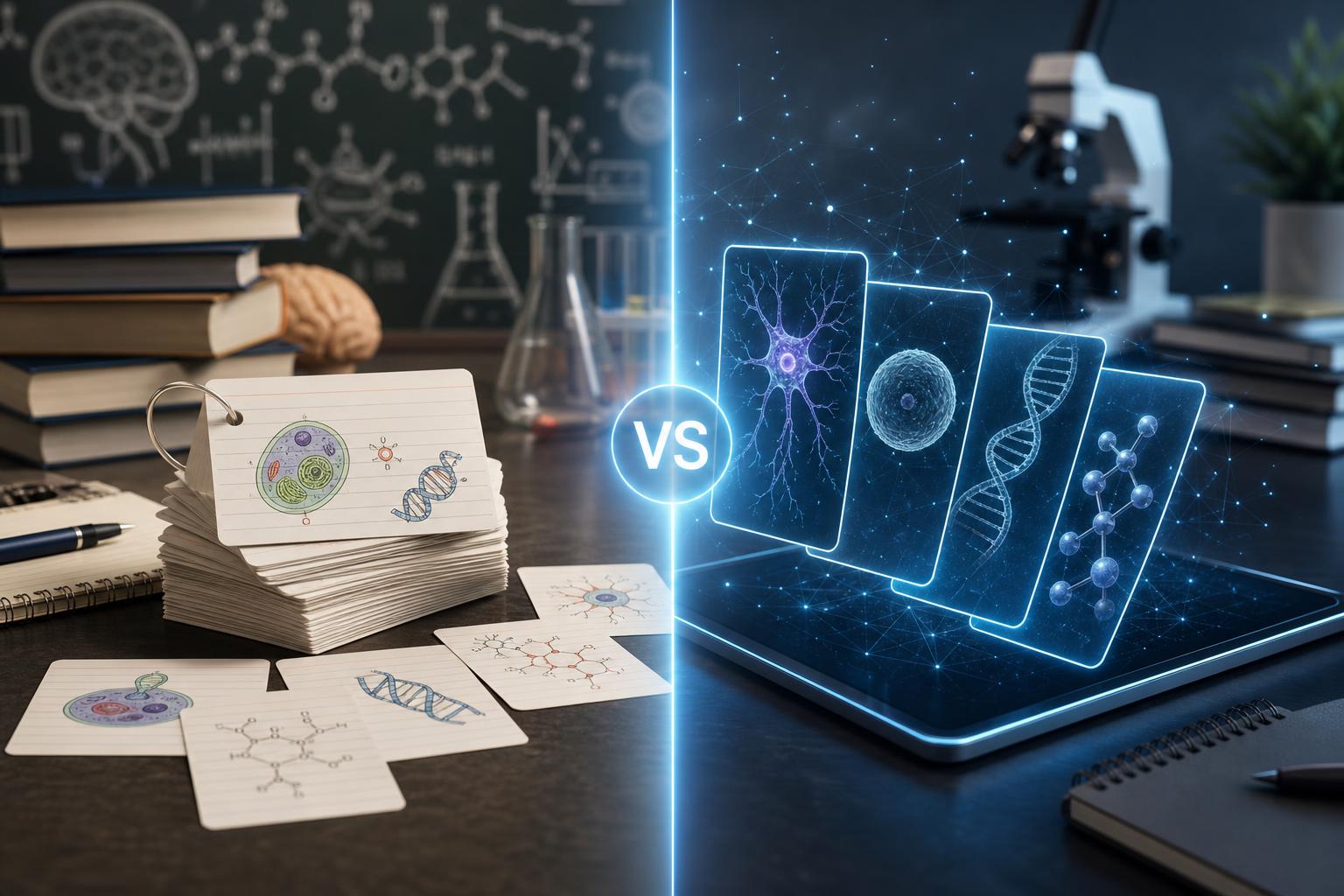
AI flashcards and traditional flashcards can both help students remember more because they use active recall: the process of pulling information from memory instead of simply rereading notes. The biggest difference is how the cards are created and improved. Traditional flashcards force you to process material manually, which can deepen understanding, but they take time and can be incomplete. AI flashcards can quickly turn lecture notes, uploaded files, or recorded lessons into practice questions, making review faster and easier to start. The best approach for most high school and college students is not AI flashcards vs traditional flashcards as an either-or choice. Use AI to generate a strong first draft, then review, edit, and personalize the cards so they match what your teacher emphasized and what you actually need to remember.
Key takeaways
- AI flashcards are effective when they are accurate, reviewed by the student, and used for active recall instead of passive reading.
- Traditional flashcards can improve learning because making them manually forces you to identify key ideas, but they are slower to create.
- AI generated flashcards from notes or recorded lectures save time and can help students review more consistently before quizzes and exams.
- The strongest retention comes from combining active recall flashcards with spaced repetition study tools and regular self-testing.
- Students should always check AI-generated cards against class notes, textbooks, rubrics, and teacher expectations before relying on them.
AI flashcards vs traditional flashcards: the main difference
Traditional flashcards are created by hand, either on paper or in a digital app. You decide what goes on the front, what answer goes on the back, and how much detail to include. This can be powerful because the act of choosing and rewriting information makes you think about the material. AI flashcards are generated automatically from a source such as lecture notes, textbook excerpts, slides, transcripts, or recorded lessons. For example, AI Study Assistant can help students record or upload a lesson, generate a transcript, and turn that class material into flashcards, summaries, notes, and quizzes. The key tradeoff is speed versus control: AI helps you create many cards quickly, while traditional card-making gives you more manual control from the start.
Are AI flashcards effective for memory and retention?
AI flashcards can be effective when they are used as active recall flashcards. Active recall means trying to answer a question before looking at the answer. This is more helpful for long-term memory than simply highlighting notes or rereading a textbook chapter. AI-generated cards can also support spaced repetition, where you review difficult cards more often and easier cards less often. However, the effectiveness depends on card quality. A vague, overly broad, or inaccurate AI card will not help much. Students should treat AI flashcards as a fast study draft: test yourself, fix weak cards, add examples from class, and remove anything that is irrelevant to the exam.
Time savings and personalization
For busy students, the biggest advantage of digital flashcards for students is time savings. Making flashcards from lecture notes manually can take an hour or more after a long class. AI generated flashcards from notes can shorten that process by pulling out definitions, causes, comparisons, formulas, dates, and key concepts automatically. Personalization still matters, though. The most useful deck is not always the largest deck. A strong flashcard set focuses on what you missed in homework, what your teacher repeated in class, and what is likely to appear on the test. AI Study Assistant is especially helpful when you want flashcards from lecture notes or recordings, but you should still edit cards to match your course level, teacher wording, and weak spots.
Accuracy checking: why students still need to review AI cards
AI can summarize and generate study questions quickly, but it can make mistakes, omit context, or create cards that are technically correct but not aligned with your class. Traditional flashcards may also contain errors if you misunderstand the material while writing them. The solution is the same for both methods: check against reliable sources. Compare AI flashcards with your lecture transcript, assigned readings, slides, lab instructions, and teacher feedback. If a card asks a question that is too broad, split it into smaller cards. If an answer is too long, simplify it. If a card seems questionable, verify it before studying. This review step turns AI output into a more trustworthy learning tool.
Which method helps students remember more?
The method that helps students remember more is the one that gets them to practice retrieval consistently. Traditional flashcards may help more during creation because you manually process the material. AI flashcards may help more over a semester because they reduce setup time, making it easier to practice often. For many students, the best strategy is hybrid: use AI Study Assistant to generate cards from your lecture recording or notes, review and edit the deck, then study with spaced repetition over several days or weeks. This gives you the speed of AI plus the learning benefits of personal review and active recall.
Best practices for using AI flashcards well
Start with a clean source, such as organized lecture notes, a readable transcript, or a clear recording. Generate flashcards, then scan the deck for accuracy, duplicates, and missing topics. Convert long answers into shorter, testable facts. Add examples, diagrams, mnemonics, or teacher-specific wording when useful. Study by answering before revealing the back of the card, and mark cards honestly based on whether you truly remembered the answer. Review difficult cards again soon, and space easier cards over longer intervals. AI is most useful when it removes busywork, not when it replaces your thinking.
Flashcards
What is the main learning benefit of both AI and traditional flashcards?
Both can support active recall, which strengthens memory by requiring students to retrieve information before seeing the answer.
What is one major advantage of AI flashcards over traditional flashcards?
AI flashcards can save time by quickly generating study cards from notes, transcripts, uploaded files, or recorded lessons.
What is one major advantage of traditional flashcards?
Creating traditional flashcards manually can deepen understanding because students must choose, organize, and rewrite key information themselves.
Why should students review AI-generated flashcards before studying?
Students should review them to check accuracy, remove irrelevant cards, fix vague wording, and align the deck with class expectations.
What does active recall mean?
Active recall means trying to retrieve an answer from memory before checking notes or revealing the flashcard answer.
How does spaced repetition improve flashcard studying?
Spaced repetition improves retention by reviewing information at increasing intervals, especially focusing more often on difficult cards.
What is a good hybrid approach to AI flashcards vs traditional flashcards?
Use AI to generate a first draft from class material, then manually edit and personalize the cards before studying them with active recall.
Why might a smaller flashcard deck be better than a very large one?
A smaller deck can be more effective if it focuses on the most important concepts, weak areas, and likely test material.
How can AI Study Assistant help students create flashcards?
AI Study Assistant can record or upload lessons, generate transcripts, and turn class material into flashcards, notes, summaries, and quizzes.
What should students do if an AI flashcard answer seems questionable?
They should verify it using class notes, textbooks, lecture slides, teacher guidance, or another reliable course source.
Quiz
1. Which statement best describes AI flashcards vs traditional flashcards?
- A. AI flashcards are always more accurate than traditional flashcards.
- B. Traditional flashcards never support active recall.
- C. Both can support memory, but AI flashcards are faster to create and traditional flashcards require more manual processing.
- D. AI flashcards only work for math classes.
Show answer
Answer: Both can support memory, but AI flashcards are faster to create and traditional flashcards require more manual processing.
Both methods can help students practice retrieval. AI mainly improves speed and convenience, while manual card creation can help students process material deeply.
2. What makes flashcards effective for learning?
- A. They force students to reread every page of a textbook.
- B. They support active recall by asking students to retrieve answers from memory.
- C. They replace all homework and class attendance.
- D. They work only when used the night before an exam.
Show answer
Answer: They support active recall by asking students to retrieve answers from memory.
Flashcards are powerful because they prompt retrieval practice, which strengthens memory more than passive review.
3. What is the best first step after generating AI flashcards from lecture notes?
- A. Study them without checking for mistakes.
- B. Delete all cards that include definitions.
- C. Review the cards for accuracy, relevance, and clarity.
- D. Print them and never edit them.
Show answer
Answer: Review the cards for accuracy, relevance, and clarity.
AI-generated flashcards should be treated as a draft. Reviewing and editing them helps ensure the deck matches the class material and exam expectations.
4. Which study habit is most likely to improve long-term retention?
- A. Cramming all cards once the night before a test.
- B. Highlighting the answers without trying to remember them.
- C. Using spaced repetition and reviewing difficult cards more often.
- D. Only studying cards that feel easy.
Show answer
Answer: Using spaced repetition and reviewing difficult cards more often.
Spaced repetition helps move information into long-term memory by spreading review over time and prioritizing weaker knowledge.
5. Why can making traditional flashcards by hand be useful?
- A. It prevents students from needing to understand the topic.
- B. It forces students to identify and organize important information.
- C. It guarantees every card will be correct.
- D. It is always faster than using AI.
Show answer
Answer: It forces students to identify and organize important information.
Manual card creation can deepen learning because students must decide what matters and how to explain it.
6. What is the strongest way to use AI Study Assistant for flashcards?
- A. Upload or record class material, generate flashcards, then review and personalize them before studying.
- B. Generate flashcards and assume every answer is perfect.
- C. Use AI flashcards only for vocabulary and never for concepts.
- D. Avoid checking the cards against course materials.
Show answer
Answer: Upload or record class material, generate flashcards, then review and personalize them before studying.
The best workflow combines AI speed with student judgment, accuracy checking, and active recall practice.
FAQs
Are AI flashcards effective for high school and college students?
Yes, AI flashcards can be effective when they are accurate, based on relevant class material, and used for active recall. They work best when students review and edit the cards instead of accepting every AI-generated question automatically.
Can AI generate flashcards from lecture notes or recordings?
Yes. Tools like AI Study Assistant can help students record or upload lessons, create transcripts, and generate flashcards from lecture notes or class recordings. This can save time and make it easier to start reviewing soon after class.
Should I use AI flashcards or make flashcards manually?
Most students benefit from a hybrid approach. Use AI to create a fast first draft, then manually edit cards, add examples, fix mistakes, and focus the deck on your weak areas and upcoming assessments.
Do AI flashcards replace studying?
No. AI flashcards reduce the time it takes to create study materials, but students still need to practice retrieval, check answers, and review over time. The learning happens when you actively try to remember and apply the information.
Next step
Turn this topic into a study session with notes, flashcards, and a practice quiz built from your own class material.

Leave a Reply