
Listen to this article
How to Make Flashcards from Class Notes: A Step-by-Step Study Guide
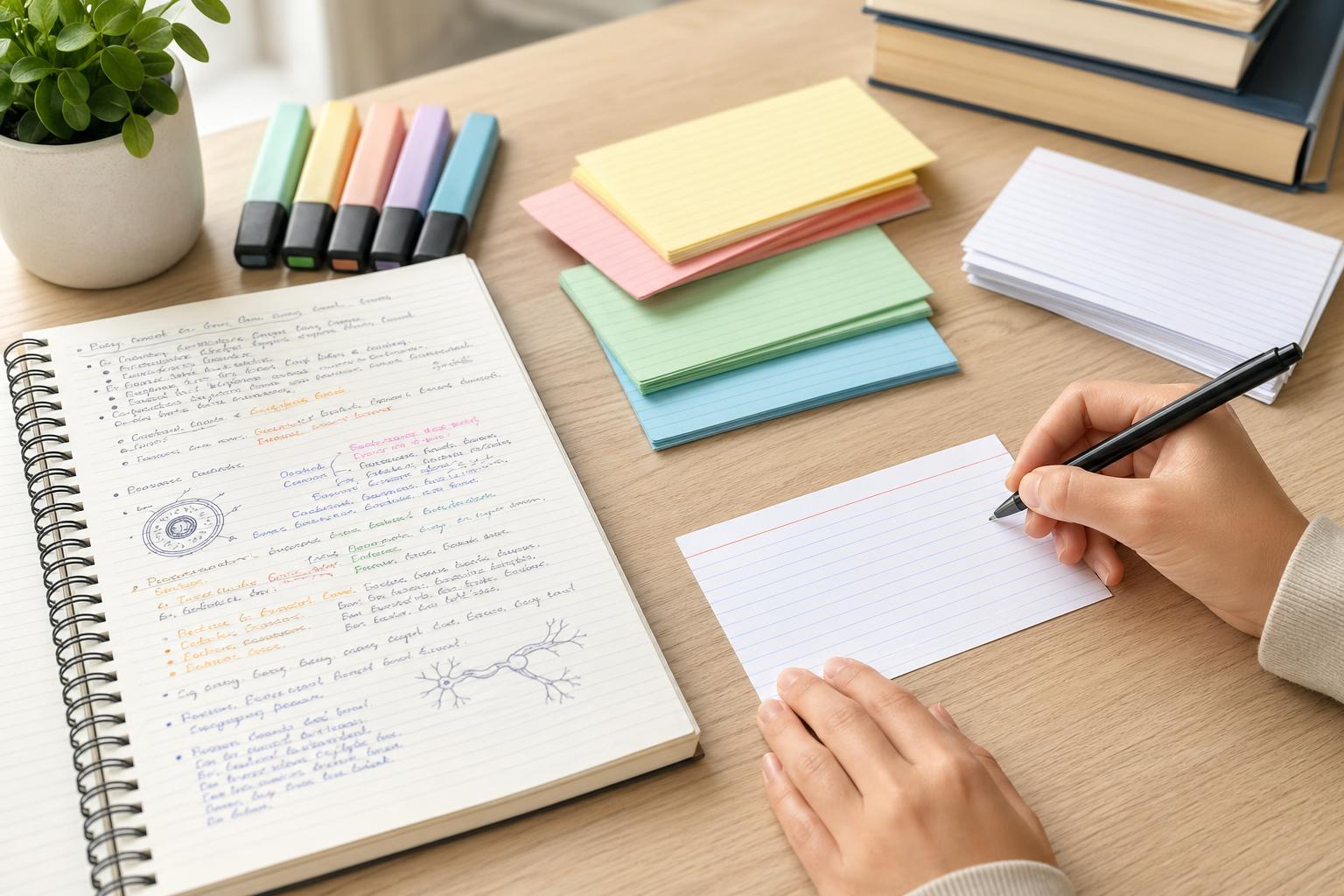
Learning how to make flashcards from class notes can help you turn long pages of information into quick, active-recall study tools. Instead of rereading everything, you can pull out definitions, formulas, dates, examples, and cause-and-effect ideas and convert them into short question-and-answer cards. The best flashcards from notes are focused, clear, and based on the material your class actually expects you to remember. By using a simple note to flashcard method, you can organize your notes, identify testable ideas, write stronger prompts, and review with spaced repetition so your study flashcards from notes are more useful and less overwhelming.
Key takeaways
- Start by identifying testable facts, concepts, vocabulary, formulas, and processes in your notes before making any cards.
- Write one idea per card so each flashcard is specific, easy to review, and better for active recall.
- Turn headings, bold terms, examples, diagrams, and teacher-emphasized points into questions instead of copying whole sentences.
- Review your flashcards from notes regularly using spaced repetition, and revise weak cards when they feel confusing or too broad.
Why flashcards work better than rereading notes
Many students highlight or reread notes, but those methods often feel productive without requiring real recall. Flashcards work because they force you to retrieve information from memory. When you take class notes and turn notes into flashcards, you change passive information into active practice. This helps with remembering vocabulary, historical events, biological processes, math formulas, language terms, and step-by-step procedures. Flashcards also make it easier to study in short sessions, sort material by difficulty, and focus on what you do not know yet. The key is to avoid copying large chunks of notes and instead convert them into clear prompts that make you think.
Step 1: Find what in your notes should become a flashcard
Before writing cards, scan your notes and mark information that is likely to appear on a quiz or exam. Good candidates include definitions, key terms, formulas, labeled diagrams, dates, causes and effects, comparisons, and important examples discussed in class. Look closely at repeated ideas, anything the instructor emphasized, and anything that answers who, what, when, where, why, or how. A useful note to flashcard method is to highlight or underline only testable points, then group them into categories such as vocabulary, concepts, processes, and examples. If a sentence contains multiple ideas, break it apart. For example, instead of using one card for an entire paragraph on photosynthesis, make separate cards for the definition, location, inputs, outputs, and purpose.
Step 2: Write stronger flashcards from notes
The best flashcards from notes are brief and focused. Put one question, term, or prompt on the front and one precise answer on the back. Avoid cards with too much information because they are harder to review and easier to guess. Good question formats include definition prompts, fill-in-the-blank cues, comparison questions, sequence questions, and application questions. For example, a weak card might ask, 'Explain everything about the water cycle.' A stronger set would ask, 'What is evaporation?' 'What is condensation?' and 'What role does the sun play in the water cycle?' If your notes include worked examples, turn them into problem cards. If your notes include diagrams, create image-based prompts or ask yourself to label parts from memory. Keep wording simple and use your own language when possible so the meaning is clear.
Step 3: Organize and review your study flashcards from notes
Once you make your cards, organize them by unit, chapter, class topic, or test date. You can use paper flashcards, an app, or both. Color-coding can help if you use it for a purpose, such as blue for vocabulary, green for formulas, and yellow for processes. During review, separate cards into piles like know, unsure, and need practice. Study the hardest cards more often, but keep revisiting old material so you do not forget it. Spaced repetition is especially helpful: review soon after class, again the next day, then after a few days, and then weekly. Shuffle cards often to avoid memorizing order. When a card repeatedly confuses you, rewrite it. The goal is not just to own flashcards, but to make flashcards that help you answer questions accurately under test conditions.
Common mistakes when you turn notes into flashcards
A common mistake is copying notes word for word. This creates dense cards that are slow to study and difficult to remember. Another mistake is putting several facts on one card, which makes it unclear what you are supposed to recall. Students also sometimes make cards only for easy vocabulary while skipping processes, examples, and relationships between ideas. Some stop after creating cards and never review them consistently. Others review by flipping too quickly instead of actually trying to answer first. To improve your results, keep each card narrow, cover a mix of fact and concept questions, and say the answer out loud before checking the back. If a card is too easy, combine it with a more useful application prompt. If it is too hard, split it into smaller cards.
Flashcards
What is the main goal when making flashcards from class notes?
To turn long notes into short prompts that support active recall.
What type of information from notes makes a good flashcard?
Definitions, formulas, dates, processes, comparisons, and key examples.
Why should you put only one main idea on each flashcard?
Because single-focus cards are easier to remember and review accurately.
What is a weak flashcard question example?
A broad prompt like 'Explain everything about this chapter.'
What is a better alternative to copying a full paragraph onto one card?
Break the paragraph into several specific question-and-answer cards.
How can teacher emphasis help when creating flashcards from notes?
It helps identify material that is more likely to be tested.
What review strategy helps flashcards from notes stay in memory longer?
Spaced repetition over several study sessions.
What should you do if a flashcard keeps feeling confusing?
Rewrite it to make the prompt clearer or split it into smaller cards.
Quiz
1. Which note content is most suitable for turning into a flashcard?
- A. A random doodle in the margin
- B. A key definition explained in class
- C. A full page copied word for word
- D. An unrelated personal reminder
Show answer
Answer: A key definition explained in class
Definitions are specific, testable, and easy to convert into a clear front-and-back flashcard.
2. What is the best reason to keep one idea per flashcard?
- A. It makes the card easier to decorate
- B. It helps the card test one clear memory target
- C. It guarantees you will never forget
- D. It removes the need to review later
Show answer
Answer: It helps the card test one clear memory target
Single-focus cards improve recall because you know exactly what you are trying to remember.
3. Which prompt is the strongest flashcard example?
- A. Explain everything from Unit 3
- B. What are the three branches of government?
- C. Study this page later
- D. Read chapter notes again
Show answer
Answer: What are the three branches of government?
A specific question creates a measurable recall task, unlike broad or passive prompts.
4. When should you first review flashcards after making them from notes?
- A. Only the night before the test
- B. Soon after class or the same day
- C. After finishing the entire course
- D. Only when a friend reminds you
Show answer
Answer: Soon after class or the same day
Early review strengthens memory and works well with spaced repetition.
5. What should you do with a flashcard that is too broad or confusing?
- A. Throw away all your cards
- B. Keep reviewing it unchanged forever
- C. Rewrite it or split it into smaller cards
- D. Add more unrelated facts to it
Show answer
Answer: Rewrite it or split it into smaller cards
Improving card clarity makes review more efficient and helps target specific knowledge.
FAQs
How many flashcards should I make from one page of notes?
There is no perfect number. Make as many as needed to cover the testable ideas clearly. A dense page may produce several cards if it includes multiple terms, steps, or examples. Focus on quality and clarity rather than reaching a specific total.
Should I use paper flashcards or digital flashcards?
Either can work. Paper flashcards are simple and flexible for quick writing, while digital tools make it easier to organize, search, and use spaced repetition. Choose the format you will actually review consistently.
Can I make flashcards for subjects that are not heavy on memorization?
Yes. Flashcards are useful for more than facts. You can make cards for math procedures, essay themes, science processes, language practice, and problem-solving steps. The key is to turn notes into targeted questions that require recall or application.
Study smarter with AI
Need help turning notes into better flashcards? AI Study Assistant can help you organize class material, create useful review prompts, and study more efficiently.

Leave a Reply