Listen to this article
How to Revise from Transcripts: A Practical Guide for Smarter Exam Prep
Learning how to revise from transcripts can save time and improve understanding, especially when your lessons come from recorded lectures, videos, meetings, or revision sessions. Instead of rereading long text passively, you can turn transcripts into structured notes, topic summaries, flashcards, and exam questions. The key is to identify the main ideas, remove filler language, organize content by themes, and actively test yourself. When used well, transcripts become a reliable study resource that helps you review complex material, catch missed points, and prepare more efficiently for exams.
Key takeaways
- Start by cleaning and organizing the transcript so important ideas stand out from repeated or filler speech.
- Break the transcript into topics, subtopics, and key terms before making revision materials.
- Turn transcript content into active recall tools such as flashcards, summary questions, and practice prompts.
- Use timestamps, headings, and teacher emphasis to spot likely exam content and priority areas.
- Combine transcript revision with past papers, class notes, and spaced repetition for stronger retention.
Why transcripts can be powerful revision tools
Transcripts give you a written version of spoken teaching, which is useful when lectures move quickly or when you miss details during class. They let you revisit exact explanations, examples, definitions, and step-by-step reasoning. This makes them especially helpful for subjects where teachers explain processes, compare ideas, or highlight common mistakes. If you want to revise from transcripts effectively, treat the transcript as raw material rather than a final study resource. Its value comes from transforming it into something easier to review. A transcript can help you confirm what was taught, identify emphasis in a lesson, and recover information you did not fully understand the first time. It is also useful for students who learn better by reading than by listening.
Step-by-step method: how to study with transcripts
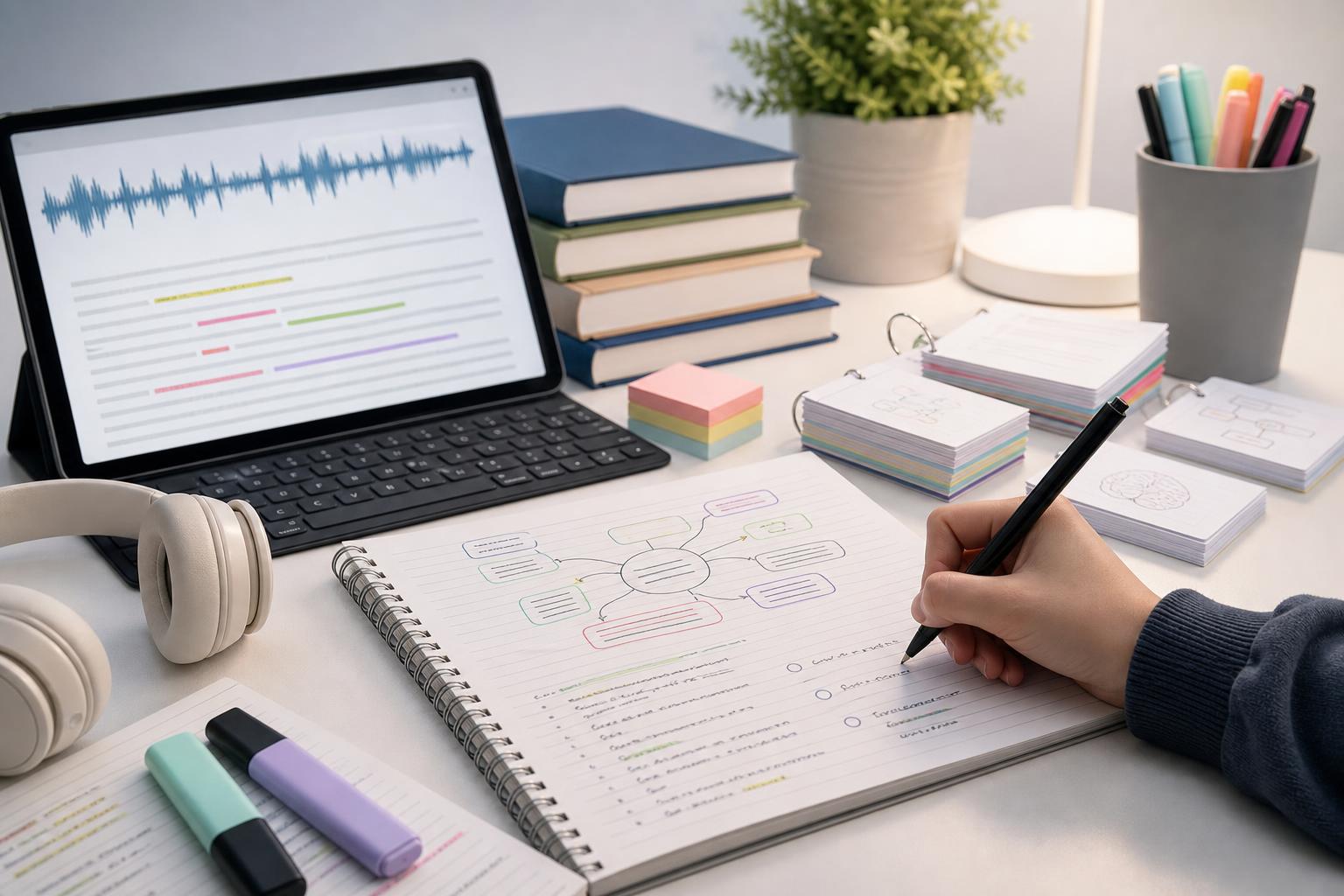
First, skim the whole transcript to understand the lesson structure. Look for topic shifts, repeated terms, definitions, examples, and any moments where the speaker says something is important. Second, clean the transcript by removing filler words, repeated phrases, off-topic discussion, and conversational parts that are not useful for exam prep. Third, divide the text into clear headings and subheadings based on themes or learning objectives. Fourth, highlight the most important content: core concepts, formulas, dates, arguments, processes, and examples. Fifth, rewrite each section in your own words as concise revision notes. Aim for short bullet points, not long paragraphs. Sixth, convert those notes into active study materials such as flashcards, self-test questions, and one-page summaries. Finally, review the material over time using spaced repetition rather than trying to memorize the transcript in one sitting.
Best transcript revision tips for exam preparation
One of the best transcript revision tips is to focus on exam relevance, not transcript completeness. Not every sentence matters equally. Prioritize definitions, teacher explanations of difficult ideas, comparisons between topics, worked examples, and anything explicitly linked to assessment. Use the transcript to identify patterns such as repeated vocabulary, cause-and-effect relationships, or steps in a method. If the transcript includes timestamps, mark sections you may want to replay for extra clarity. Another useful strategy is color coding: one color for key ideas, another for examples, and another for likely exam questions. You can also create a margin system where you label parts of the transcript with tags like definition, evidence, formula, example, mistake, or summary. This helps you find information quickly later. For stronger exam prep, pair transcript notes with your syllabus and past paper topics so your revision stays targeted.
How to turn a transcript into notes, flashcards, and practice questions
To turn a transcript into useful notes, compress each major section into 3 to 5 bullet points that answer: What is the idea? Why does it matter? What example was used? What could be tested in an exam? For flashcards, place a term, concept, or question on one side and a short answer on the other. Good flashcards come from definitions, distinctions, steps in a process, and teacher-asked questions. For practice questions, rewrite the lesson into prompts such as explain, compare, define, evaluate, outline, or apply. You can also build mini quizzes from the transcript by turning examples into problem-solving tasks. If the transcript contains a case study or worked solution, cover the explanation and try to reproduce it yourself. This moves you from passive reading to active retrieval, which is much more effective for memory. The final goal is not to remember the transcript word for word, but to understand and recall the ideas confidently under exam conditions.
Flashcards
What is the first thing to do when revising from a transcript?
Skim the full transcript to understand the overall lesson structure and main topics.
Why should you remove filler language from a transcript?
It makes key ideas clearer and turns the transcript into a more efficient revision resource.
What types of content should be prioritized in transcript revision?
Definitions, core concepts, examples, formulas, processes, and points the teacher emphasizes.
How can transcripts support exam preparation?
They help you recover missed details, identify important explanations, and create targeted study materials.
What is a good way to organize transcript content?
Divide it into headings and subheadings based on themes, topics, or learning objectives.
How do you convert transcript notes into active recall practice?
Turn them into flashcards, self-test questions, and short summary prompts.
Why is rewriting transcript content in your own words useful?
It improves understanding and reduces passive copying, which helps memory.
What should be the goal of studying with transcripts?
To understand, organize, and recall the main ideas rather than memorize every line.
Quiz
1. What is the most effective way to use a transcript for revision?
- A. Read it once and highlight everything
- B. Memorize the transcript word for word
- C. Turn the transcript into organized notes and self-test materials
- D. Only use the transcript the night before the exam
Show answer
Answer: Turn the transcript into organized notes and self-test materials
Transcripts work best when transformed into concise notes, flashcards, and practice questions that support active recall.
2. Which part of a transcript is usually most useful for exam prep?
- A. Off-topic classroom conversation
- B. Repeated filler phrases
- C. Definitions and worked examples
- D. Speaker hesitations
Show answer
Answer: Definitions and worked examples
Definitions and worked examples often contain the kind of knowledge and application skills that are tested in exams.
3. Why should students rewrite transcript content in their own words?
- A. To make the transcript longer
- B. To avoid understanding the topic too quickly
- C. To improve comprehension and retention
- D. To copy the lecture exactly
Show answer
Answer: To improve comprehension and retention
Rewriting in your own words forces you to process meaning, which strengthens learning and memory.
4. What is a strong method for organizing a long transcript?
- A. Split it into topics and subtopics
- B. Delete all examples
- C. Ignore headings
- D. Study every line equally
Show answer
Answer: Split it into topics and subtopics
Breaking the transcript into manageable sections makes it easier to review, summarize, and revise.
5. How should transcripts be used alongside other revision resources?
- A. As the only source of study
- B. Together with notes, the syllabus, and past papers
- C. Instead of doing practice questions
- D. Only after the exam
Show answer
Answer: Together with notes, the syllabus, and past papers
Combining transcripts with other resources keeps revision accurate, focused, and aligned with likely exam demands.
FAQs
Can I revise effectively from transcripts if I missed the live lesson?
Yes. A transcript can help you recover the content of a missed lesson, especially if you organize it into notes, identify the main ideas, and follow up with active recall practice.
Are transcripts better than lecture notes?
Not always. Transcripts are usually more detailed, but lecture notes are often more concise. The best approach is to use the transcript to fill gaps and then combine it with your class notes for a cleaner revision set.
What is the biggest mistake when trying to revise from transcripts?
The biggest mistake is treating the transcript as something to reread passively. Effective revision comes from selecting key information, summarizing it, and testing yourself on it.
Study smarter with AI
Turn long transcripts into clear notes, flashcards, and revision questions faster with AI Study Assistant. It is built to help you apply the exact strategies from this guide to your own exam prep.
Related guides
- How to study for an exam from one lecture
- Best way to study with recorded lectures
- How to make quiz questions from notes
- How to catch up after missing a lecture
- How to summarize a long lecture fast
- How to study from lecture recordings
- How to turn a lecture into notes
- How to make flashcards from class notes

Leave a Reply