
Listen to this article
Derivatives Basics Study Guide
This derivatives basics study guide gives students a clear starting point for understanding one of the central ideas in calculus: the derivative. A derivative measures how a function changes, connects directly to slope and rates of change, and is used across math, science, economics, and engineering. In this guide, you will review the meaning of derivatives, common notation, foundational rules, worked ideas, and practice tools like derivatives flashcards and a derivatives quiz to strengthen recall and problem-solving.
Key takeaways
- A derivative represents the instantaneous rate of change of a function and the slope of a tangent line at a point.
- Derivative notation may appear as f'(x), y', dy/dx, or d/dx[f(x)], and all describe the same core idea.
- Core rules such as the power rule, constant rule, sum rule, product rule, quotient rule, and chain rule make differentiation efficient.
- Derivatives help analyze motion, optimization, graph behavior, and real-world change in many fields.
- Success with derivatives improves when students connect formulas to meaning, practice notation, and solve short problems regularly.
What a derivative means
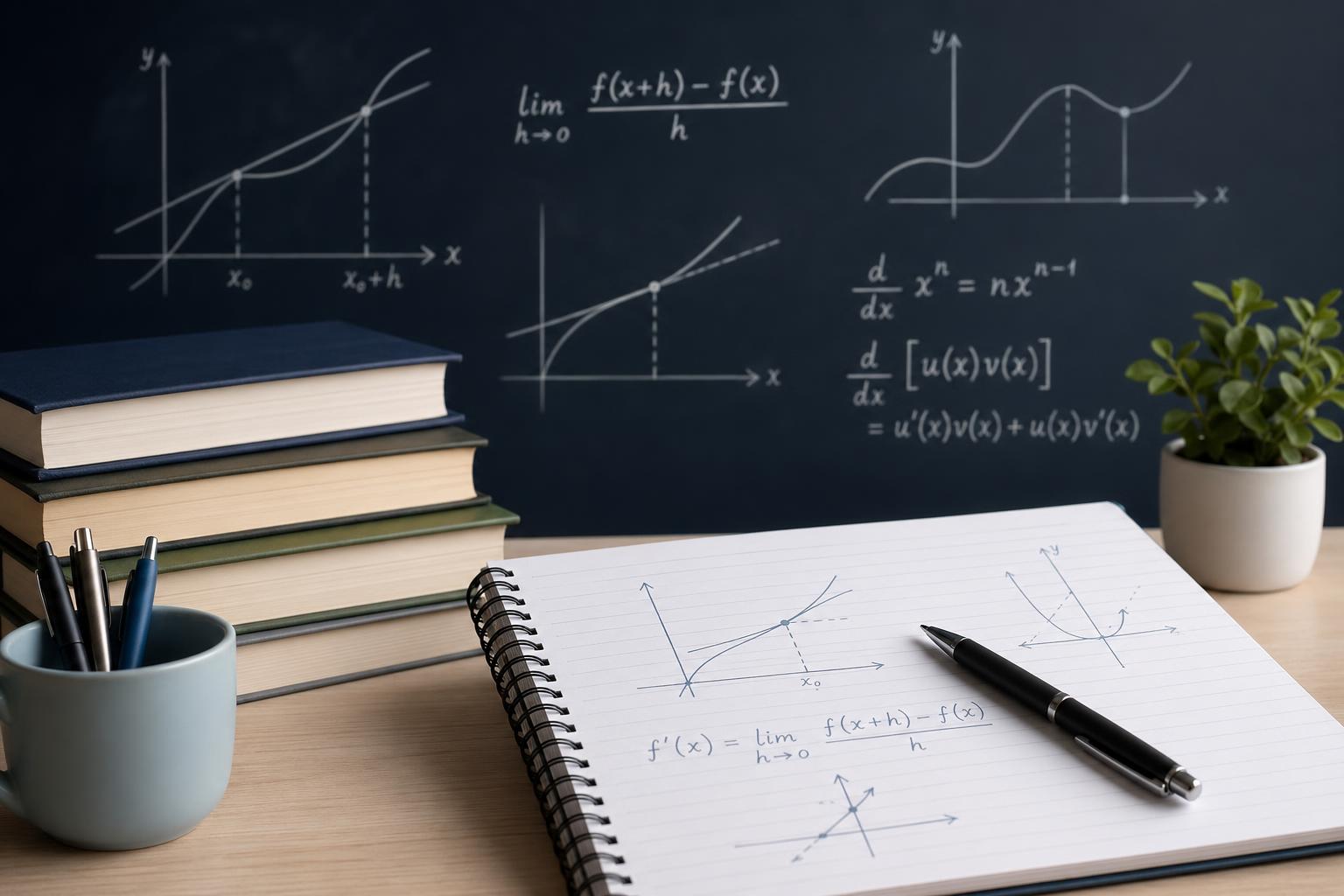
In calculus, a derivative tells you how fast a function is changing at a specific input value. If you picture the graph of a function, the derivative at a point is the slope of the tangent line there. This makes derivatives useful for describing instantaneous change rather than average change over an interval. For example, if position is given as a function of time, the derivative of position gives velocity. If cost depends on production level, the derivative shows how cost changes as output changes. The formal idea comes from limits. The derivative of f at x is defined by the limit of the difference quotient: [f(x+h)-f(x)]/h as h approaches 0. This compares how output changes over a tiny input change. As the interval shrinks, the average rate of change becomes the instantaneous rate of change. Even when students mostly use rules to compute derivatives, remembering this limit definition helps explain why derivatives measure slope and change.
Derivative notation and core concepts
Students often see several notations in their derivatives notes. If y = f(x), then the derivative may be written as f'(x), y', dy/dx, or d/dx[f(x)]. These all refer to the derivative with respect to x. When a derivative is evaluated at a number, such as f'(2), it gives the slope of the curve at x = 2. A few basic ideas are essential. If f'(x) is positive on an interval, the function is increasing there. If f'(x) is negative, the function is decreasing. If f'(x) = 0 at a point, the graph may have a horizontal tangent, which is often important in optimization problems. Derivatives can also fail to exist at corners, cusps, vertical tangents, or discontinuities. Understanding where a derivative exists and what its sign means is an important part of any calculus derivatives summary.
Essential derivative rules
Most beginning differentiation problems rely on a small set of rules. The constant rule says the derivative of a constant is 0. The power rule says d/dx[x^n] = nx^(n-1), which is one of the most important tools in basic calculus. The constant multiple rule lets you carry constants through differentiation, and the sum and difference rules allow term-by-term differentiation. For products and quotients, use specialized rules. The product rule is (fg)' = f'g + fg'. The quotient rule is (f/g)' = (f'g – fg')/g^2, assuming g is not zero. For compositions of functions, use the chain rule: if y = f(g(x)), then y' = f'(g(x))·g'(x). This rule is critical when differentiating expressions like (3x^2 + 1)^5 or sqrt(2x+7). Students who memorize rules without recognizing the structure of the function often make errors, so always identify whether the expression is a sum, product, quotient, or composition before differentiating.
Common examples and study tips
Here are a few standard examples. If f(x) = x^3, then f'(x) = 3x^2 by the power rule. If g(x) = 4x^5 – 2x + 9, then g'(x) = 20x^4 – 2. If h(x) = (x^2 + 1)(x – 3), use the product rule: h'(x) = 2x(x – 3) + (x^2 + 1)(1). If p(x) = (2x + 5)^4, use the chain rule: p'(x) = 4(2x + 5)^3 · 2 = 8(2x + 5)^3. To study effectively, build a short routine. First, review meaning and notation so formulas are not disconnected from ideas. Next, group problems by rule type: power, product, quotient, and chain. Then check your work for common mistakes such as forgetting exponents decrease by one, dropping factors in the chain rule, or misusing the quotient rule. Finally, use derivatives flashcards for quick recall and a derivatives quiz to test whether you can choose the correct rule before computing. Strong calculus performance comes from repeated, focused practice rather than passive reading alone.
Flashcards
What does a derivative represent geometrically?
The slope of the tangent line to the graph at a point.
What does a derivative represent in terms of change?
The instantaneous rate of change of a function.
What is the derivative of a constant c?
0
What is the power rule for d/dx[x^n]?
nx^(n-1)
Write one common notation for the derivative of y = f(x).
f'(x)
What is the derivative of x^3?
3x^2
Which rule is used to differentiate (x^2 + 1)(x – 3)?
The product rule.
Which rule is used to differentiate (2x + 5)^4?
The chain rule.
Quiz
1. What is the derivative of f(x) = x^4?
- A. 4x^3
- B. x^3
- C. 4x
- D. x^5
Show answer
Answer: 4x^3
By the power rule, d/dx[x^4] = 4x^3.
2. Which notation means the derivative of y with respect to x?
- A. dy/dx
- B. Δy
- C. x/y
- D. ∫y dx
Show answer
Answer: dy/dx
dy/dx is standard notation for the derivative of y with respect to x.
3. What is the derivative of g(x) = 7x – 2?
- A. 7
- B. 7x
- C. -2
- D. 1
Show answer
Answer: 7
The derivative of 7x is 7 and the derivative of the constant -2 is 0.
4. Which rule is most appropriate for differentiating (3x^2 + 1)^5?
- A. Chain rule
- B. Quotient rule
- C. Product rule
- D. Constant rule
Show answer
Answer: Chain rule
The function is a composition: an outer power function applied to an inner polynomial.
5. If f'(x) is negative on an interval, what does that tell you about f(x) on that interval?
- A. It is decreasing
- B. It is increasing
- C. It is constant
- D. It is undefined
Show answer
Answer: It is decreasing
A negative derivative indicates the function values decrease as x increases on that interval.
FAQs
Why do students learn the limit definition if most derivatives use rules?
The limit definition explains what a derivative actually means. It shows that a derivative comes from shrinking an average rate of change into an instantaneous rate of change, which is why derivatives describe slope and real-time change.
What is the difference between average rate of change and derivative?
Average rate of change compares function values over an interval and is computed with a secant slope. A derivative gives the instantaneous rate of change at a single point and corresponds to the tangent slope.
What are the most common mistakes in basic derivative problems?
Common mistakes include using the wrong rule, forgetting to lower the exponent in the power rule, missing the inner derivative in chain rule problems, and making sign errors in product or quotient rule calculations.
Study derivatives smarter
Use AI Study Assistant to review derivative rules, generate practice problems, and turn this derivatives basics study guide into personalized study sessions.

Leave a Reply