
Listen to this article
Limits Study Guide
Limits describe what value a function approaches as the input gets closer and closer to a particular number. They are one of the main foundations of calculus because they help define continuity, derivatives, and integrals. This limits study guide explains the meaning of limits, how to evaluate them, what one-sided and infinite limits mean, and how to recognize common limit situations. Use it as a calculus limits summary, a quick source of limits notes, and a practice tool before quizzes, tests, or a full calculus unit review.
Key takeaways
- A limit describes the value a function approaches, not necessarily the value the function actually equals at a point.
- Limits can often be found by direct substitution, factoring, rationalizing, using common limit laws, or analyzing a graph.
- One-sided limits must match for a two-sided limit to exist.
- Infinite limits describe unbounded behavior, while limits at infinity describe end behavior.
- Limits are essential for understanding continuity, derivatives, tangent slopes, and many later calculus topics.
What Is a Limit?
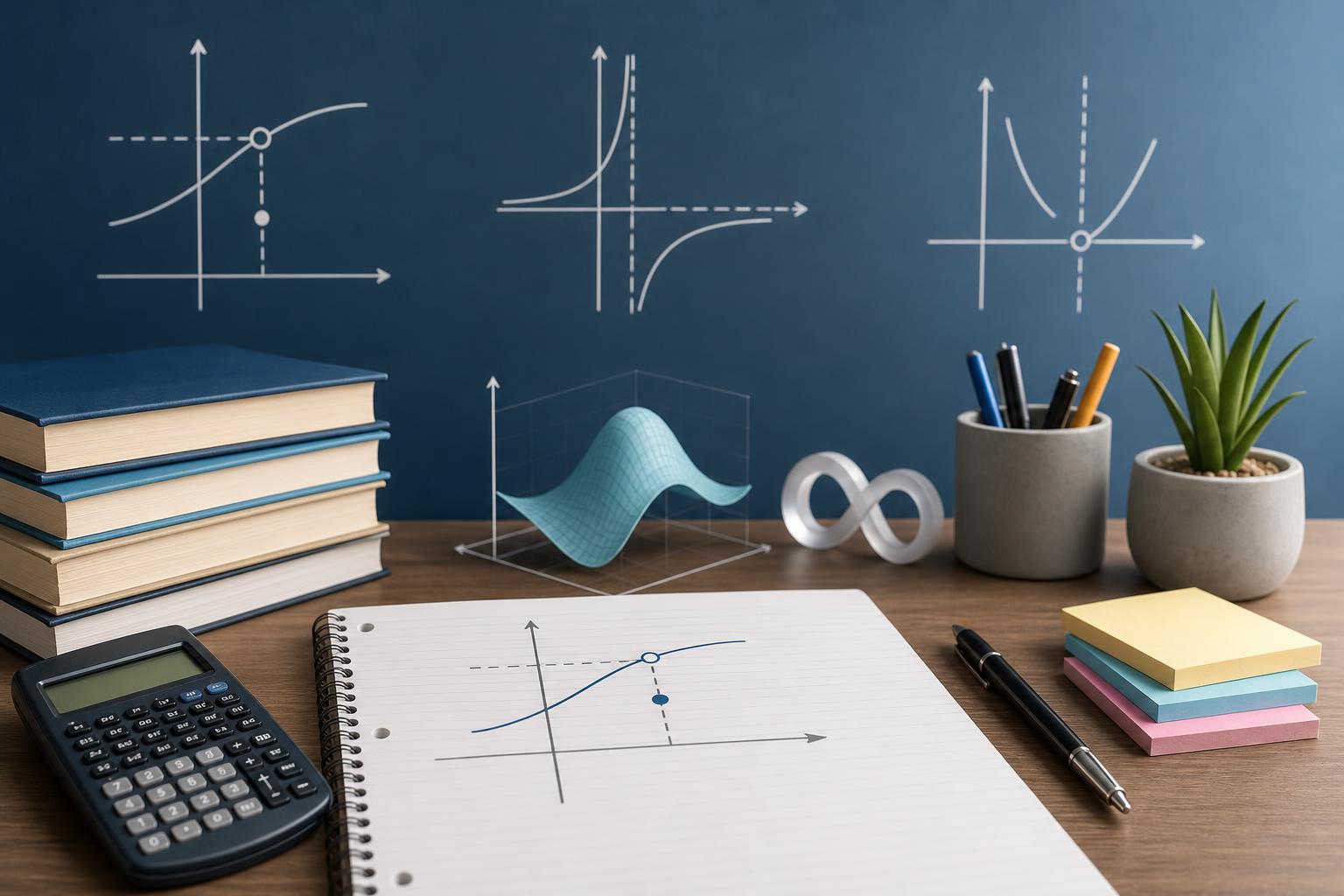
A limit tells us what happens to the output of a function as the input approaches a specific value. The notation lim x→a f(x) = L means that as x gets closer to a, f(x) gets closer to L. The function does not have to actually equal L when x = a, and the function may even be undefined at x = a. What matters is the behavior near the point, from both sides unless a one-sided limit is being considered.
How to Evaluate Limits
The first method to try is direct substitution. If substituting x = a gives a real number and the function is defined normally there, that value is usually the limit. If substitution gives an indeterminate form such as 0/0, more work is needed. Common algebraic strategies include factoring and canceling, simplifying complex fractions, rationalizing expressions with radicals, or using known special limits. A graph or table can also help estimate a limit, especially when the function is piecewise or difficult to simplify.
One-Sided Limits and Two-Sided Limits
A left-hand limit describes what f(x) approaches as x approaches a from values less than a, written lim x→a− f(x). A right-hand limit describes what f(x) approaches as x approaches a from values greater than a, written lim x→a+ f(x). For the two-sided limit lim x→a f(x) to exist, the left-hand and right-hand limits must both exist and must be equal. If they approach different values, the two-sided limit does not exist.
Infinite Limits and Limits at Infinity
An infinite limit occurs when a function grows without bound near a specific x-value. For example, a vertical asymptote may cause f(x) to approach infinity or negative infinity as x approaches a. A limit at infinity studies what happens to f(x) as x becomes extremely large or extremely negative. These limits are often used to find horizontal asymptotes and describe the long-term behavior of functions.
Why Limits Matter in Calculus
Limits are the language used to define major calculus ideas. A derivative is defined as a limit of average rates of change, which gives the instantaneous rate of change or slope of a tangent line. Definite integrals are connected to limits of sums. Continuity is also defined using limits: a function is continuous at a point if the function value exists, the limit exists, and the two are equal. Strong limit skills make later calculus topics much easier to understand.
Flashcards
What does lim x→a f(x) = L mean?
It means f(x) approaches the value L as x gets closer and closer to a.
Does a function have to be defined at x = a for lim x→a f(x) to exist?
No. A limit can exist even if the function is undefined at the point.
What should you try first when evaluating a limit algebraically?
Try direct substitution first.
What does the indeterminate form 0/0 usually mean?
It means more simplification or analysis is needed before the limit can be found.
When does a two-sided limit exist?
A two-sided limit exists when the left-hand and right-hand limits both exist and are equal.
What is a left-hand limit?
It is the value a function approaches as x approaches a from values less than a.
What is an infinite limit?
An infinite limit occurs when a function increases or decreases without bound as x approaches a value.
What are limits at infinity used to describe?
They describe the end behavior of a function as x becomes very large or very negative.
How are limits related to derivatives?
Derivatives are defined using limits of average rates of change.
What are the three conditions for continuity at a point?
The function value must exist, the limit must exist, and the function value must equal the limit.
Quiz
1. What does a limit describe?
- A. The value a function approaches
- B. Only the exact value of a function at a point
- C. The highest y-value of a function
- D. The x-intercept of a graph
Show answer
Answer: The value a function approaches
A limit describes the value f(x) approaches as x gets close to a specified input.
2. If the left-hand limit and right-hand limit are different, what happens to the two-sided limit?
- A. It does not exist
- B. It equals their average
- C. It equals the left-hand limit
- D. It equals the right-hand limit
Show answer
Answer: It does not exist
A two-sided limit exists only when both one-sided limits exist and are equal.
3. Which method is usually best to try first when evaluating a simple limit?
- A. Direct substitution
- B. Graphing the derivative
- C. Finding the area under the curve
- D. Using the quadratic formula
Show answer
Answer: Direct substitution
Direct substitution is often the quickest first step when the function is defined normally at the target input.
4. What does the form 0/0 indicate in many limit problems?
- A. The expression is indeterminate
- B. The answer is always 0
- C. The answer is always 1
- D. The limit is automatically infinite
Show answer
Answer: The expression is indeterminate
The form 0/0 does not give a final answer; it usually means the expression needs factoring, canceling, rationalizing, or another technique.
5. What type of asymptote is commonly associated with an infinite limit near a finite x-value?
- A. Vertical asymptote
- B. Horizontal asymptote
- C. Slant asymptote
- D. No asymptote
Show answer
Answer: Vertical asymptote
When a function grows without bound as x approaches a finite value, the graph often has a vertical asymptote there.
6. Which statement best describes continuity at x = a?
- A. The function value exists, the limit exists, and they are equal
- B. The function has a maximum at x = a
- C. The left-hand limit is always greater than the right-hand limit
- D. The function must be a polynomial
Show answer
Answer: The function value exists, the limit exists, and they are equal
Continuity at a point requires f(a) to exist, lim x→a f(x) to exist, and the two values to be the same.
FAQs
What is the easiest way to start a limits problem?
Start with direct substitution. If it gives a defined real number, that is often the limit. If it gives an indeterminate form such as 0/0, simplify the expression or use a graph, table, or known limit rule.
Can a limit exist if the function has a hole in the graph?
Yes. If the graph approaches the same y-value from both sides of the hole, the limit exists even though the function may be undefined or have a different value at that x-coordinate.
What is the difference between an infinite limit and a limit at infinity?
An infinite limit describes f(x) becoming unbounded as x approaches a finite value. A limit at infinity describes what f(x) approaches as x becomes extremely large or extremely negative.
Why are limits important before learning derivatives?
Derivatives are built from limits. The derivative uses a limit to turn the slope between two nearby points into the instantaneous slope at one point.
Next step
Turn this topic into a study session with notes, flashcards, and a practice quiz built from your own class material.

Leave a Reply