Listen to this article
AI Notes vs Handwritten Notes: Which Is Better for Remembering Lectures?
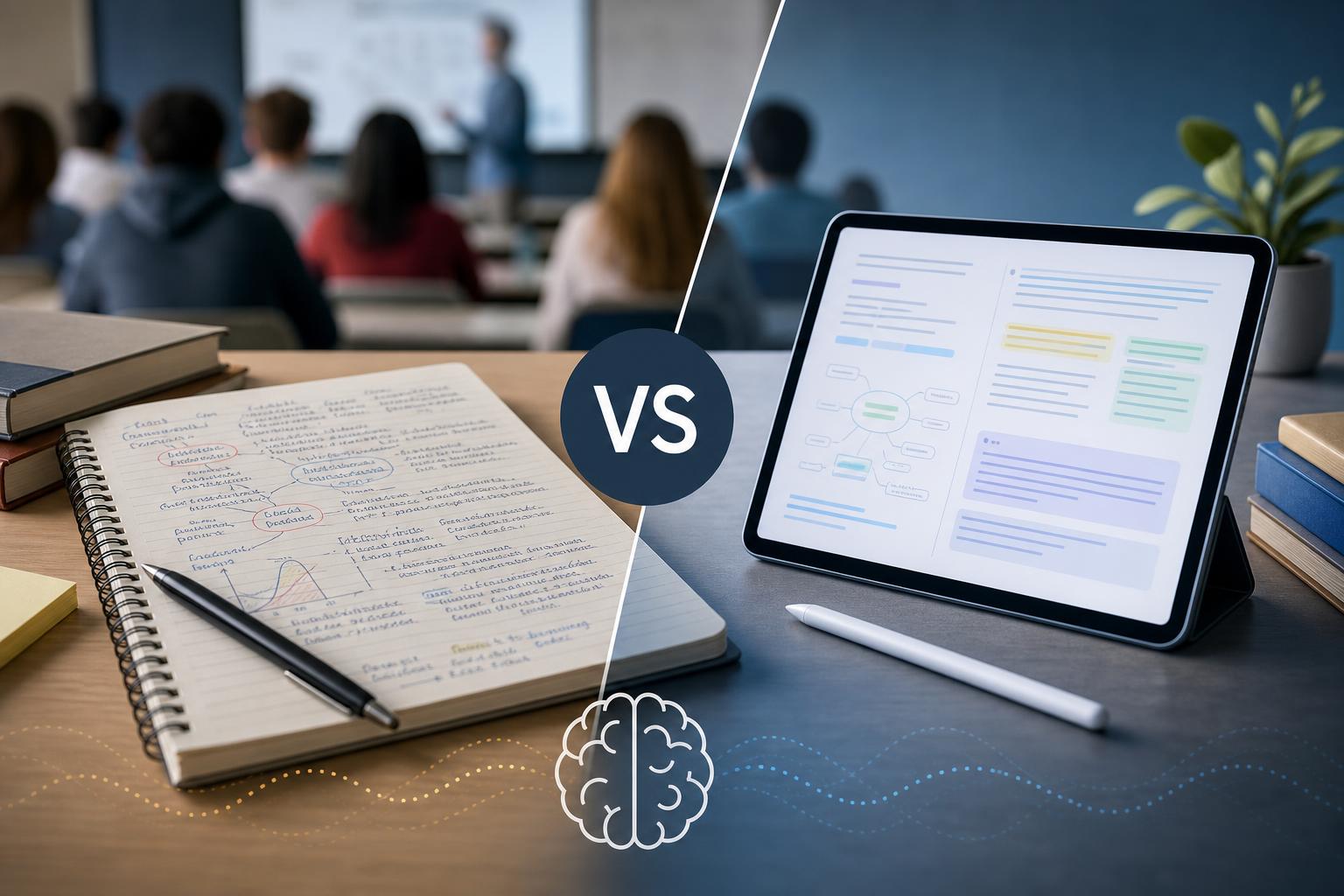
In the AI notes vs handwritten notes debate, neither method is automatically better for every student or class. Handwriting can encourage you to select, summarize, and process ideas as you hear them, while AI-generated notes can capture details you miss and create organized review materials quickly. For most high school and college students, the best approach is a hybrid one: use AI Study Assistant to record or upload the lesson, generate a transcript and study materials, then actively annotate key concepts, retrieve them from memory, and practice with flashcards or quizzes.
Key takeaways
- Handwritten notes can support retention when you summarize ideas in your own words instead of copying the lecture verbatim.
- AI notes provide broad coverage, searchable transcripts, and fast study-material generation, but reviewing them passively is unlikely to produce strong learning.
- The best note-taking method for students depends on lecture speed, subject complexity, accessibility needs, and how the notes will be reviewed.
- A hybrid workflow combines reliable AI capture with active annotation, self-explanation, retrieval practice, and spaced review.
- Whether notes are created by hand or by AI, the quality of your follow-up study usually matters more than the format alone.
AI notes vs handwritten notes at a glance
Handwritten notes prioritize active selection. Because writing by hand is slower than most lectures, students often have to identify the main point, shorten explanations, and translate ideas into their own words. That process can make note-taking a learning activity rather than a simple recording task. AI-generated notes prioritize coverage and convenience. A lecture recording or uploaded lesson can be converted into a transcript, summary, structured notes, flashcards, and practice questions. This is useful when an instructor speaks quickly, presents dense material, or explains a concept that requires your full visual attention. The trade-off is straightforward: handwritten notes can promote deeper processing during class, while AI notes reduce the chance that important details will be lost. Neither advantage guarantees retention. A student who mindlessly copies by hand may learn less than one who actively reviews AI notes, and a student who merely saves an AI summary may remember less than one who creates and tests handwritten explanations.
When handwritten notes may be better for retention
Handwriting is especially useful when the lecture requires interpretation rather than complete transcription. As you decide what to write, you can identify relationships, distinguish examples from core principles, and reorganize information into a form that makes sense to you. Handwritten notes may work well for discussion-based classes, conceptual subjects, diagrams, equations, and courses in which the instructor clearly signals the most important ideas. They can also limit unrelated notifications and browser distractions. However, handwriting is not automatically active learning. Copying slides word for word, writing without understanding, or never revisiting the pages weakens its value. Handwritten notes can also be incomplete, difficult to search, and hard to keep organized. If the lecturer moves quickly, focusing on writing every detail may cause you to miss the explanation behind those details.
Are AI lecture notes effective?
AI lecture notes can be effective when they support attention and active review. They are particularly valuable for fast lectures, content-heavy courses, revision across multiple lessons, or situations in which a student needs a transcript for accessibility. Searchable notes also make it easier to locate definitions, examples, dates, formulas, and instructor explanations. AI Study Assistant can turn a recorded or uploaded lesson into a transcript, summary, notes, flashcards, and quizzes. This reduces time spent formatting materials and gives students more time to test their understanding. AI output still needs student oversight. Transcripts can mishear technical terms, names, formulas, or unclear audio. Summaries may omit a nuance that the instructor considers important. Students should compare generated materials with slides, assigned readings, and their own observations. They should also follow school rules, obtain permission when required, and avoid recording private discussions without consent.
Digital notes vs handwritten notes by study situation
For a fast, detail-heavy lecture, AI notes often provide better coverage. For a slow conceptual lesson, handwriting may help you process the argument as it develops. In mathematics, chemistry, physics, or economics, handwritten work can be helpful for equations, diagrams, and multi-step reasoning, while an AI transcript can preserve the instructor's verbal explanation of why each step works. For exam review, searchable AI notes make it easier to combine and organize material from several lectures. Handwritten concept maps, worked examples, and one-page summaries can then help compress that material into memorable structures. Students with motor, hearing, language-processing, or attention-related needs may also find automated capture helpful, although the appropriate method depends on the individual and available accommodations. Instead of asking which format wins in every category, ask which method solves the problem in front of you: capturing details, maintaining attention, understanding relationships, or practicing recall.
The best hybrid note-taking workflow for students
1. Before class, preview the lesson title, objectives, or assigned reading. Write two or three questions you expect the lecture to answer. 2. During class, use AI Study Assistant to capture the lesson when recording is permitted. Take brief handwritten or typed annotations only for questions, confusing points, diagrams, instructor emphasis, and connections to prior material. This keeps you engaged without forcing you to transcribe every sentence. 3. Soon after class, check the generated transcript and notes for errors. Correct technical terms, formulas, names, and claims that do not match the lecture or course materials. 4. Reduce the lesson to a short set of essential ideas. Write each idea in your own words and add one example, comparison, equation, or application. This active compression is more valuable than simply rereading a complete transcript. 5. Close the notes and retrieve the material from memory. Answer generated quiz questions, explain the topic aloud, or sketch a concept map without looking. 6. Review again over multiple days. Use flashcards for definitions and relationships, practice problems for procedures, and short-answer prompts for explanations. Mark weak areas and return to the relevant portion of the lecture.
How to remember lectures better, regardless of note format
Treat notes as raw material for practice, not as the finished product. Rereading can make information feel familiar without proving that you can recall or use it. After reviewing a section, hide it and write what you remember. Then compare your answer with the source and correct gaps. Use self-explanation for difficult concepts: state what the idea means, why it matters, how it connects to prior knowledge, and when it applies. For quantitative subjects, solve a new problem without copying the demonstrated steps. For humanities and social sciences, compare arguments, generate examples, and answer likely essay prompts. Keep AI convenience from becoming passive dependence. Verify important content, personalize summaries, and attempt questions before viewing answers. Keep handwriting from becoming mechanical copying by using abbreviations, questions, diagrams, and paraphrases. In both cases, repeated retrieval and application are the steps most directly connected to exam-ready knowledge.
Flashcards
What is the main strength of handwritten lecture notes?
They can encourage students to select, paraphrase, and organize information while listening.
What is the main strength of AI-generated lecture notes?
They can capture broad lecture content and quickly create searchable transcripts and review materials.
Why does slower handwriting sometimes support learning?
It can force the student to identify important ideas instead of trying to record every word.
What is a major risk of relying only on AI notes?
The student may review passively or accept transcription and summary errors without verification.
What is a major risk of relying only on handwritten notes?
Important details may be missed while the student is writing, especially during a fast lecture.
What should students verify in AI-generated notes?
Technical terms, formulas, names, nuanced explanations, and other details that may have been transcribed or summarized incorrectly.
What is retrieval practice?
Trying to recall or apply information without looking at the notes, then checking the response for gaps.
What does a hybrid note-taking workflow combine?
AI capture and organization with student annotation, paraphrasing, verification, and active practice.
When may AI notes be especially helpful?
During fast, dense lectures or when a searchable transcript improves access and review.
How should students use notes after class?
Condense key ideas, explain them in their own words, test recall, correct errors, and review weak areas over time.
Quiz
1. Which approach best combines lecture coverage with active learning?
- A. Record the lesson with AI and never review it
- B. Copy every slide by hand without listening
- C. Use AI capture, annotate key ideas, and practice retrieval
- D. Read the transcript once before the exam
Show answer
Answer: Use AI capture, annotate key ideas, and practice retrieval
A hybrid approach preserves lecture content while requiring the student to process, verify, and retrieve the material.
2. Why can handwritten notes support retention?
- A. Handwriting automatically stores every lecture detail
- B. Students may need to select and paraphrase ideas
- C. Handwritten pages never contain mistakes
- D. Writing removes the need for later review
Show answer
Answer: Students may need to select and paraphrase ideas
Selecting and restating ideas can produce deeper processing than verbatim copying, although later practice is still necessary.
3. What should a student do first after receiving AI-generated lecture notes?
- A. Assume every detail is correct
- B. Delete the original materials
- C. Share the recording publicly
- D. Check important terms and ideas against the lesson
Show answer
Answer: Check important terms and ideas against the lesson
Verification helps catch errors in technical vocabulary, formulas, names, and summarized explanations.
4. Which activity is the clearest example of retrieval practice?
- A. Highlighting the transcript repeatedly
- B. Recalling the main ideas with the notes closed
- C. Changing the font of the summary
- D. Listening to the lecture while multitasking
Show answer
Answer: Recalling the main ideas with the notes closed
Retrieval practice requires bringing information to mind without relying on the source during the attempt.
5. In which situation might AI notes offer the strongest immediate advantage?
- A. A fast lecture containing many details
- B. A private conversation recorded without permission
- C. A drawing exercise with no verbal instruction
- D. An exam that prohibits all devices
Show answer
Answer: A fast lecture containing many details
AI capture can preserve more of a fast, information-dense lecture, provided recording is allowed and the output is checked.
FAQs
Are AI notes better than handwritten notes for exams?
AI notes can make exam preparation faster by organizing multiple lectures and generating review materials. Handwritten summaries may help you process and compress the most important ideas. The strongest approach is often to use AI for capture and organization, then use active recall, practice problems, and personalized annotations to prepare for the exam.
Does handwriting notes always improve memory?
No. Handwriting is most useful when it involves selecting, paraphrasing, connecting, or visually organizing ideas. Copying information without understanding it and never reviewing the notes is unlikely to produce strong retention.
Can I rely on an AI lecture summary instead of attending class?
Usually not. A summary may omit demonstrations, context, instructor emphasis, class discussion, and subtle explanations. Attendance also gives you opportunities to ask questions and notice what the instructor considers important. Use AI notes as a support for participation and review, not as a guaranteed replacement.
How soon should I review lecture notes?
Review them as soon as practical after class while the context is still familiar. Correct errors, identify the essential ideas, and complete a short recall attempt. Follow that with additional practice over several days rather than relying on one long rereading session.
Next step
Turn this topic into a study session with notes, flashcards, and a practice quiz built from your own class material.
Related guides
- AI lecture notes vs manual note taking
- How to take better notes from online classes and recorded lectures
- How to record lectures and turn them into notes
- How to turn recorded lectures into notes
- How to turn recorded lectures into study notes
- How to turn lecture recordings into notes
- Best AI lecture note taker for students
- Best AI note-taking apps for college students

Leave a Reply