Listen to this article
Best App That Turns Lectures into Flashcards: What to Look For
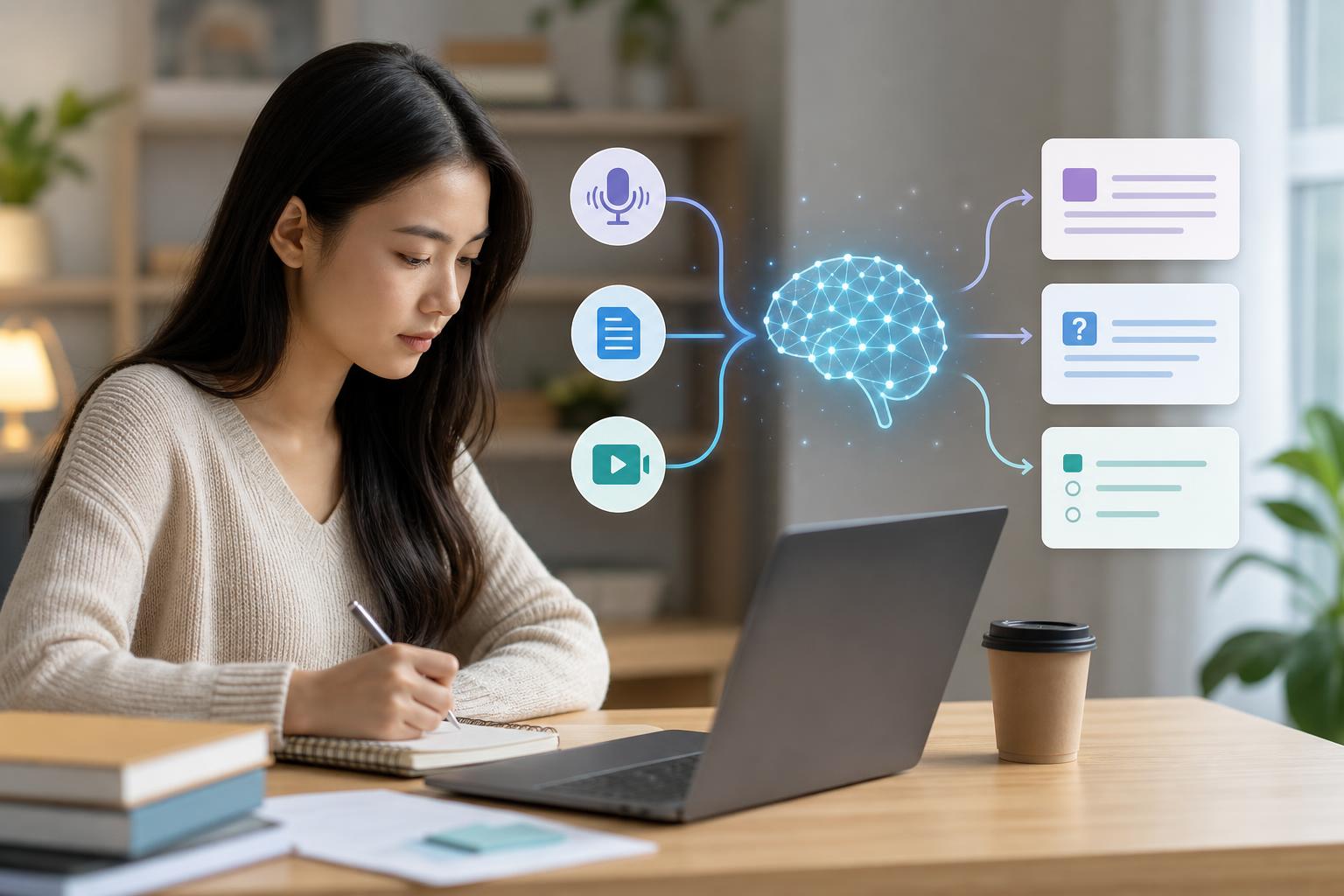
If you are looking for an app that turns lectures into flashcards, the best choice is one that does more than create isolated question-and-answer cards. A strong lecture to flashcards app should record or accept uploaded class audio, generate an accurate transcript, identify the most testable concepts, and turn those concepts into useful review materials. AI Study Assistant is built for this workflow: students can upload or record lessons, then generate summaries, notes, flashcards, and quizzes from their own class material so study time starts with what was actually taught.
Key takeaways
- An effective app that turns lectures into flashcards should support recording, audio upload, transcription, summaries, flashcards, and quizzes in one workflow.
- AI-generated flashcards are most useful when they are based on your actual lecture content rather than generic study sets.
- Look for a lecture to flashcards app that preserves context, separates key ideas from minor details, and helps you review actively.
- AI Study Assistant is designed for students who want to convert lectures, recordings, and notes into organized study materials quickly.
- The best class recording flashcard app should help you move from passive listening to active recall and practice testing.
What Is an App That Turns Lectures into Flashcards?
An app that turns lectures into flashcards uses AI to process class recordings, uploaded audio, or lesson files and convert the content into question-and-answer study cards. Instead of manually replaying a lecture and writing cards one by one, students can use the app to extract definitions, key concepts, processes, formulas, dates, comparisons, and likely exam points. The most useful tools do not stop at flashcards. They also create transcripts, summaries, notes, and practice quizzes so students can understand the material before memorizing it.
How AI Study Assistant Fits This Workflow
AI Study Assistant is designed for students who want to turn real class material into study resources. You can record or upload a lecture, generate a transcript, and convert that lesson into summaries, notes, flashcards, and quizzes. This makes it especially useful for students who learn from spoken explanations, long lectures, online classes, seminars, or review sessions. Because the flashcards are generated from your own lesson content, they are more aligned with your instructor’s wording, emphasis, and course expectations than generic flashcard decks.
Comparison: What to Look For in a Lecture to Flashcards App
When comparing lecture to flashcards app options, prioritize tools that handle the full learning process. Basic audio to flashcards tools may only create simple Q&A cards, while stronger study platforms help you capture the lecture, understand the transcript, review organized notes, and test yourself. Important features include accurate transcription, support for recorded and uploaded lessons, editable flashcards, clear summaries, quiz generation, mobile and web access, and a study flow that encourages active recall. For most students, the best option is not just a flashcard generator but a complete AI study assistant.
Why Flashcards from Lectures Are Better Than Generic Decks
Generic flashcard decks can be helpful for broad subjects, but they may not match what your professor actually emphasized. AI flashcards from lectures are based on the explanations, examples, and terminology used in your class. That matters because exams often reflect the way material was taught. A class recording flashcard app can capture specific definitions, case studies, problem-solving steps, and instructor-highlighted details that may not appear in a public study deck. This helps students study with materials that are more relevant and personalized.
Best Use Cases for Audio to Flashcards
Audio to flashcards is useful for lecture-heavy courses, exam review, language learning, medical and nursing terminology, law concepts, history timelines, science processes, and business frameworks. It is also helpful for students who commute, attend online classes, or prefer listening before reviewing. After recording or uploading a lecture, students can use AI Study Assistant to create a transcript, scan the summary, review notes, practice flashcards, and finish with a quiz. This sequence supports comprehension, recall, and self-testing.
How to Get Better AI Flashcards from Lectures
To get better flashcards, start with clear audio whenever possible. Record close to the speaker, reduce background noise, and upload complete lecture files rather than short fragments when context matters. After the cards are generated, review and edit them so they match your instructor’s expectations. Strong flashcards usually ask one clear question, focus on one concept, and include a concise answer. For complex topics, break one broad idea into several smaller cards. Pair flashcard review with practice quizzes to check whether you can apply the material, not just recognize it.
Flashcards
What does an app that turns lectures into flashcards do?
It converts recorded or uploaded lecture content into question-and-answer study cards, often using transcription and AI concept extraction.
Why are AI flashcards from lectures often more relevant than generic flashcards?
They are based on the specific content, examples, wording, and emphasis from a student’s own class material.
What is an important feature of a strong lecture to flashcards app?
It should support transcription, summaries, notes, flashcards, and quizzes so students can study from one complete workflow.
How does AI Study Assistant help students review lectures?
It lets students record or upload lessons, generates transcripts, and turns the material into summaries, notes, flashcards, and quizzes.
What study method do flashcards support?
Flashcards support active recall by prompting students to retrieve information from memory.
Why should students edit AI-generated flashcards?
Editing helps make the cards more accurate, focused, and aligned with the instructor’s expectations.
What makes a good flashcard question?
A good flashcard question is clear, focused on one concept, and paired with a concise answer.
Quiz
1. What is the main purpose of an app that turns lectures into flashcards?
- A. To convert lecture content into study cards
- B. To replace all classroom attendance
- C. To create social media posts from lectures
- D. To grade final exams automatically
Show answer
Answer: To convert lecture content into study cards
A lecture to flashcards app helps students transform recorded or uploaded class material into flashcards for review.
2. Which feature is most important for creating flashcards from recorded lectures?
- A. Accurate transcription
- B. Photo filters
- C. Music streaming
- D. Calendar wallpaper
Show answer
Answer: Accurate transcription
Accurate transcription allows the app to understand the lecture content before generating useful study materials.
3. Why can lecture-based flashcards be better than generic decks?
- A. They reflect the actual class material
- B. They are always shorter
- C. They remove the need to study
- D. They only include vocabulary words
Show answer
Answer: They reflect the actual class material
Flashcards generated from lectures are tailored to what was actually taught, including instructor examples and emphasis.
4. Which workflow best supports studying with AI Study Assistant?
- A. Upload or record a lecture, generate notes, review flashcards, take a quiz
- B. Skip the transcript and guess the exam questions
- C. Only listen to the lecture once
- D. Delete the notes before reviewing
Show answer
Answer: Upload or record a lecture, generate notes, review flashcards, take a quiz
A complete workflow helps students move from lecture capture to comprehension, recall, and practice testing.
5. What learning technique do flashcards primarily support?
- A. Active recall
- B. Passive scrolling
- C. Background multitasking
- D. Random guessing
Show answer
Answer: Active recall
Flashcards require students to retrieve information from memory, which strengthens learning and retention.
6. What should students do after AI generates flashcards from a lecture?
- A. Review and edit the cards for accuracy
- B. Assume every card is perfect forever
- C. Avoid using the transcript
- D. Convert the cards into unrelated topics
Show answer
Answer: Review and edit the cards for accuracy
Reviewing and editing improves the quality of AI-generated flashcards and helps align them with course expectations.
FAQs
What is the best app that turns lectures into flashcards?
The best app depends on your study workflow, but AI Study Assistant is a strong option for students who want to record or upload lectures and turn them into transcripts, summaries, notes, flashcards, and quizzes in one place.
Can AI Study Assistant turn audio into flashcards?
Yes. AI Study Assistant can work from recorded or uploaded lesson material, generate a transcript, and use that content to create flashcards and other study resources.
Are AI flashcards from lectures accurate?
AI flashcards can be very helpful, especially when the audio is clear and the transcript is accurate. Students should still review and edit generated cards to confirm details, correct terminology, and match instructor expectations.
Who should use a class recording flashcard app?
A class recording flashcard app is useful for students in lecture-heavy courses, online classes, exam review periods, and any situation where spoken lessons need to be converted into organized study materials.
Next step
Turn this topic into a study session with notes, flashcards, and a practice quiz built from your own class material.

Leave a Reply