Listen to this article
How to Create Practice Quizzes From Class Notes
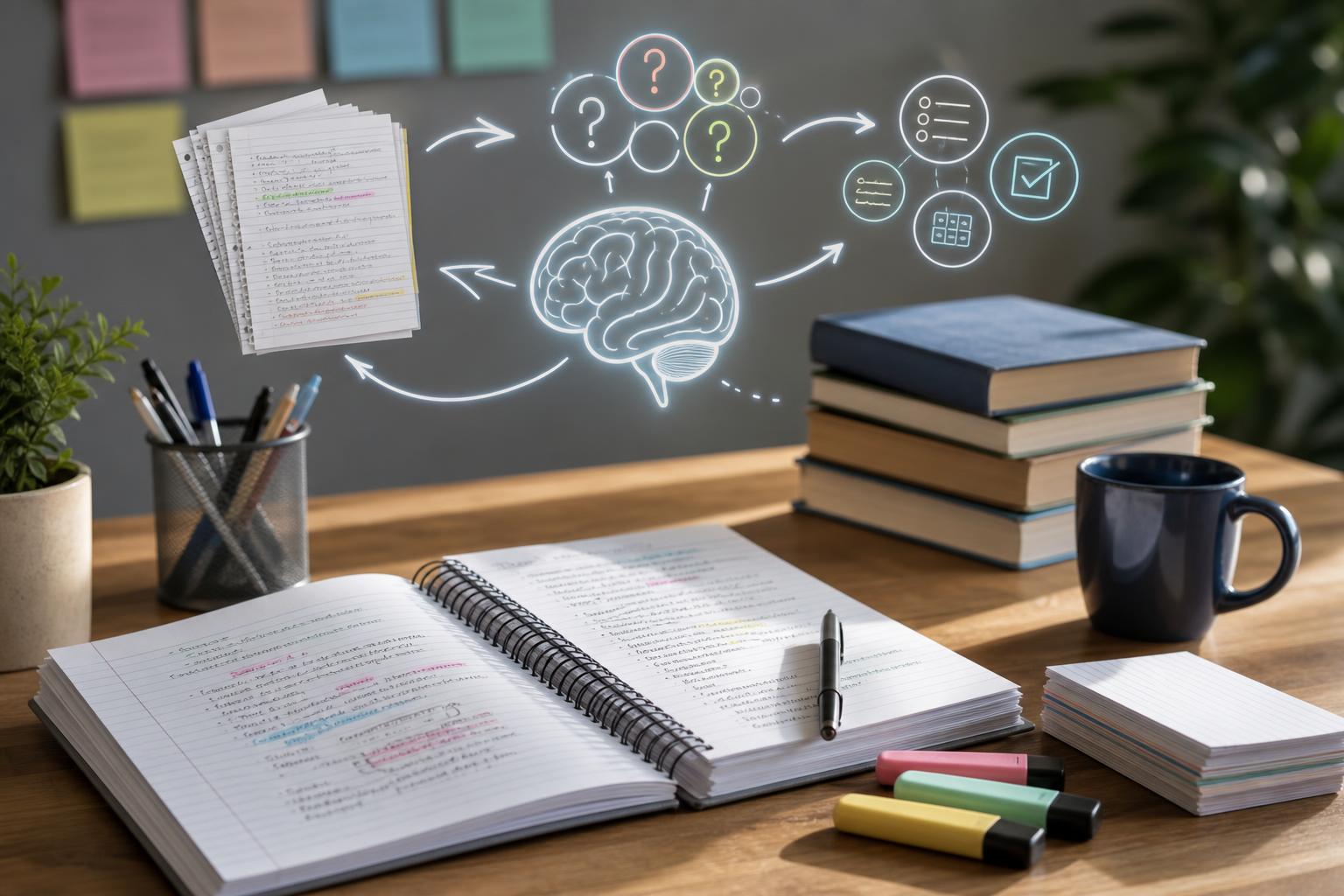
To create practice quizzes from class notes, identify the most testable concepts, convert them into questions, mix recall and application formats, and include clear answers or explanations. Then take the quiz without looking at your notes, review every mistake, and repeat difficult questions after a delay. You can build a quiz manually or use an AI quiz generator for students, such as AI Study Assistant, to turn notes, recordings, or lecture transcripts into practice questions based on material your class actually covered.
Key takeaways
- Build questions from learning objectives, major concepts, definitions, examples, processes, formulas, and instructor emphasis—not isolated details alone.
- Combine multiple-choice, short-answer, true-or-false, matching, and application questions to test different levels of understanding.
- Use easy, medium, and hard questions so the quiz measures basic recall as well as explanation, comparison, and problem-solving skills.
- Take each quiz without notes, check answers only after finishing, and record why each incorrect response was wrong.
- Repeat missed or uncertain questions with spaced self-testing instead of immediately retaking the identical quiz from memory.
- AI Study Assistant can turn uploaded notes, lesson recordings, or lecture transcripts into summaries, flashcards, and practice quizzes grounded in your class material.
1. Organize Your Class Notes Around Testable Material
Before writing questions, divide your notes into topics or learning objectives. Mark definitions, formulas, dates, processes, diagrams, comparisons, worked examples, and ideas your instructor repeated. These items are likely to be useful quiz targets. Create a short checklist for each topic: – What terms must I define? – What process must I explain in order? – Which ideas could I compare or distinguish? – What formula, rule, or method must I apply? – Which examples demonstrate the concept? – What misunderstandings did the instructor warn about? Avoid turning every sentence into a question. A useful practice test prioritizes concepts that support the course objectives and connects details to larger ideas. If your notes are incomplete, compare them with assigned materials or use a lecture transcript to recover missing context.
2. Turn Notes Into Different Question Formats
Use several formats when you turn notes into a quiz. Each format measures a different kind of knowledge. **Multiple choice:** Best for definitions, distinctions, causes, consequences, and common misconceptions. Write one clearly correct answer and three plausible distractors. Distractors should reflect realistic errors rather than random statements. **Short answer:** Useful for active recall because no options provide hints. Ask for a definition, explanation, calculation, list, or brief comparison. **True or false:** Helpful for checking precise claims, but require a correction when a statement is false. This prevents guessing from becoming the whole task. **Matching:** Efficient for related sets such as terms and definitions, people and contributions, formulas and uses, or events and outcomes. **Sequencing:** Appropriate for scientific processes, historical events, procedures, and problem-solving steps. **Application or scenario questions:** Ask students to use a concept in a new situation. These questions are especially valuable when an exam is likely to test analysis rather than simple memorization. For example, a biology note stating that enzymes lower activation energy could become a recall question asking what enzymes do, a comparison question contrasting catalyzed and uncatalyzed reactions, or an application question predicting how an enzyme affects a reaction graph.
3. Set Easy, Medium, and Hard Difficulty Levels
A balanced practice quiz should progress beyond recognition. Label questions by cognitive demand rather than by how obscure the fact is. – **Easy:** Recall a term, fact, formula, or step directly stated in the notes. – **Medium:** Explain an idea, compare two concepts, interpret an example, or connect information from different parts of the lesson. – **Hard:** Apply a principle to a new scenario, solve a multi-step problem, evaluate evidence, or identify the best explanation for an unfamiliar case. A practical starting mix is 30% easy, 50% medium, and 20% hard. Adjust it to resemble your instructor’s assessments. If class tests emphasize essays or calculations, include more constructed-response and multi-step items. Difficulty should come from deeper thinking—not confusing wording, trivia, or trick questions.
4. Create a Quiz Manually or With AI Study Assistant
To make a test from lecture notes manually, choose a topic, write questions before writing answers, create an answer key, and check that every answer is supported by the source material. Remove ambiguous wording and duplicate questions. For a faster workflow, upload notes, a lesson recording, or a lecture to AI Study Assistant. The app generates a transcript from recorded material and can turn lesson content into summaries, notes, flashcards, and quizzes. This makes it easier to create practice questions from transcripts rather than relying on a generic question bank that may not match your course. After generating a quiz, review it before studying. Confirm that terminology matches your class, remove material your instructor did not cover, and edit any question with more than one defensible answer. AI can accelerate quiz creation, but your syllabus, instructor guidance, and assigned materials should determine what belongs on the final practice set.
5. Take the Quiz as a Closed-Note Self-Test
Practice quizzes work best as self-testing, not as guided note review. Put away your notes, set a reasonable time limit, and answer every question before checking the key. For short-answer items, say or write the complete answer rather than deciding that you would have known it. Add a confidence rating to each response: – **High:** I knew the answer and could explain it. – **Medium:** I answered correctly but hesitated or guessed between choices. – **Low:** I guessed, left it blank, or answered incorrectly. Confidence reveals hidden knowledge gaps. A lucky correct answer with low confidence needs more review, while a confidently wrong answer may signal a misconception that requires careful correction.
6. Review Answers and Build a Knowledge-Gap Log
Do not stop at the score. Review correct, guessed, and incorrect responses. For each weak item, record the topic, your answer, the correct answer, why your reasoning failed, and what you will do next. Classify mistakes into useful categories: – **Knowledge gap:** The information was missing from memory. – **Conceptual confusion:** Two ideas were mixed up. – **Application error:** The concept was known but used incorrectly. – **Process or calculation error:** A step, sign, unit, or operation was wrong. – **Question-reading error:** A qualifier such as “except” or “most likely” was missed. Then return to the relevant part of your notes and explain the correct idea in your own words. Create one or two new questions that test the same concept from a different angle. This turns answer review into targeted learning rather than passive correction.
7. Repeat Quizzes With Spaced Self-Testing
Retaking the same quiz immediately can inflate confidence because you may remember the answer position or wording. Instead, space your attempts and vary the questions. A simple schedule is to test yourself after the lesson, again one to three days later, about a week later, and once more before the exam. Spend more time on missed and low-confidence topics while continuing to include some mastered material. Shuffle question order, change scenarios, convert multiple-choice questions into short-answer prompts, and combine topics in later quizzes. For cumulative exam preparation, create small topic quizzes first and then a mixed practice test. Mixed quizzes require you to identify which concept or method applies, making practice more similar to an actual exam.
Flashcards
What material in class notes should be prioritized when creating a practice quiz?
Prioritize learning objectives, major concepts, definitions, formulas, processes, comparisons, examples, and ideas emphasized by the instructor.
Why should a practice quiz include multiple question formats?
Different formats test different skills, including recognition, active recall, explanation, sequencing, comparison, and application.
What makes a multiple-choice distractor effective?
It should be plausible and reflect a realistic misconception or error while remaining clearly incorrect according to the class material.
How does a hard practice question differ from an easy one?
An easy question usually asks for direct recall, while a hard question requires application, multi-step reasoning, evaluation, or transfer to a new scenario.
What is closed-note self-testing?
It is answering practice questions without consulting notes or the answer key until the attempt is complete.
Why should correct answers with low confidence be reviewed?
They may have resulted from guessing or uncertain reasoning, so they do not yet demonstrate reliable mastery.
What should a knowledge-gap log contain?
It should include the topic, original response, correct answer, reason for the mistake, and a specific follow-up action.
Why is an immediate identical quiz retake less useful?
It can measure short-term memory for wording or answer positions instead of durable understanding.
What is spaced self-testing?
It is repeating retrieval practice after increasing delays so knowledge must be recalled over time.
How can AI Study Assistant help create practice quizzes?
It can turn uploaded class notes, lesson recordings, or lecture transcripts into study materials such as summaries, flashcards, and quizzes.
Quiz
1. Which approach produces the most useful practice questions from class notes?
- A. Testing only isolated facts from the margins
- B. Prioritizing objectives, major concepts, processes, and instructor emphasis
- C. Copying every sentence and removing one word
- D. Using questions unrelated to the assigned material
Show answer
Answer: Prioritizing objectives, major concepts, processes, and instructor emphasis
High-value quiz questions should reflect the central knowledge and skills students are expected to learn.
2. Which question format provides the fewest answer cues and therefore strongly supports active recall?
- A. Short answer
- B. Multiple choice
- C. Matching
- D. True or false
Show answer
Answer: Short answer
Short-answer questions require students to retrieve and construct a response without choosing from provided options.
3. Which task is the best example of a hard application question?
- A. Define a term exactly as written in the notes
- B. Identify a formula from a list
- C. Match four terms to their definitions
- D. Use a principle to explain an unfamiliar scenario
Show answer
Answer: Use a principle to explain an unfamiliar scenario
Applying a learned principle in a new context requires transfer and deeper reasoning rather than direct recall.
4. What should you do after answering a question correctly but with low confidence?
- A. Treat the topic as fully mastered
- B. Delete the question from future quizzes
- C. Review the reasoning and test the concept again later
- D. Immediately memorize the option letter
Show answer
Answer: Review the reasoning and test the concept again later
A low-confidence correct answer may be a guess, so the underlying concept should be checked and revisited.
5. Which self-testing plan is most likely to support durable exam preparation?
- A. Retake an identical quiz immediately until every option looks familiar
- B. Read the answer key before every attempt
- C. Take one quiz only on the night before the exam
- D. Repeat varied quizzes after delays and focus on weak topics
Show answer
Answer: Repeat varied quizzes after delays and focus on weak topics
Spacing, variation, and targeted review require repeated retrieval and direct study time toward unresolved knowledge gaps.
FAQs
How many questions should I create from one class lecture?
Start with roughly 10 to 20 focused questions, depending on the lecture’s length and complexity. Cover each major objective at least once, then add questions for important applications or common misconceptions. Quality and coverage matter more than generating a question from every line of notes.
Can I use AI to turn notes into a quiz?
Yes. An AI quiz generator for students can quickly create questions from uploaded notes or transcripts. AI Study Assistant can process lesson materials and generate quizzes alongside transcripts, summaries, notes, and flashcards. Review generated questions to verify accuracy, course alignment, terminology, and answer clarity.
How often should I take practice quizzes before an exam?
Use short self-tests throughout the unit rather than waiting until the final review session. A simple pattern is to test after learning the material, again one to three days later, about a week later, and before the exam. Adapt the timing to your course schedule and revisit weak concepts more frequently.
Should I use multiple-choice or short-answer questions?
Use both. Multiple-choice questions can test distinctions and misconceptions, while short-answer questions reduce answer cues and demand stronger retrieval. Add application, sequencing, or calculation questions when those formats match your course assessments.
Next step
Turn this topic into a study session with notes, flashcards, and a practice quiz built from your own class material.
Related guides
- Create practice quizzes from class notes
- Create practice quiz from lecture notes
- Create practice quizzes from lecture notes
- Exam prep checklist from lecture notes
- How to catch up on a missed class using lesson recordings
- How to take better notes from online classes and recorded lectures
- AI flashcard generator from lecture notes
- AI notes vs handwritten notes

Leave a Reply