Listen to this article
AI Flashcards From Class Notes: How Students Can Study With Active Recall
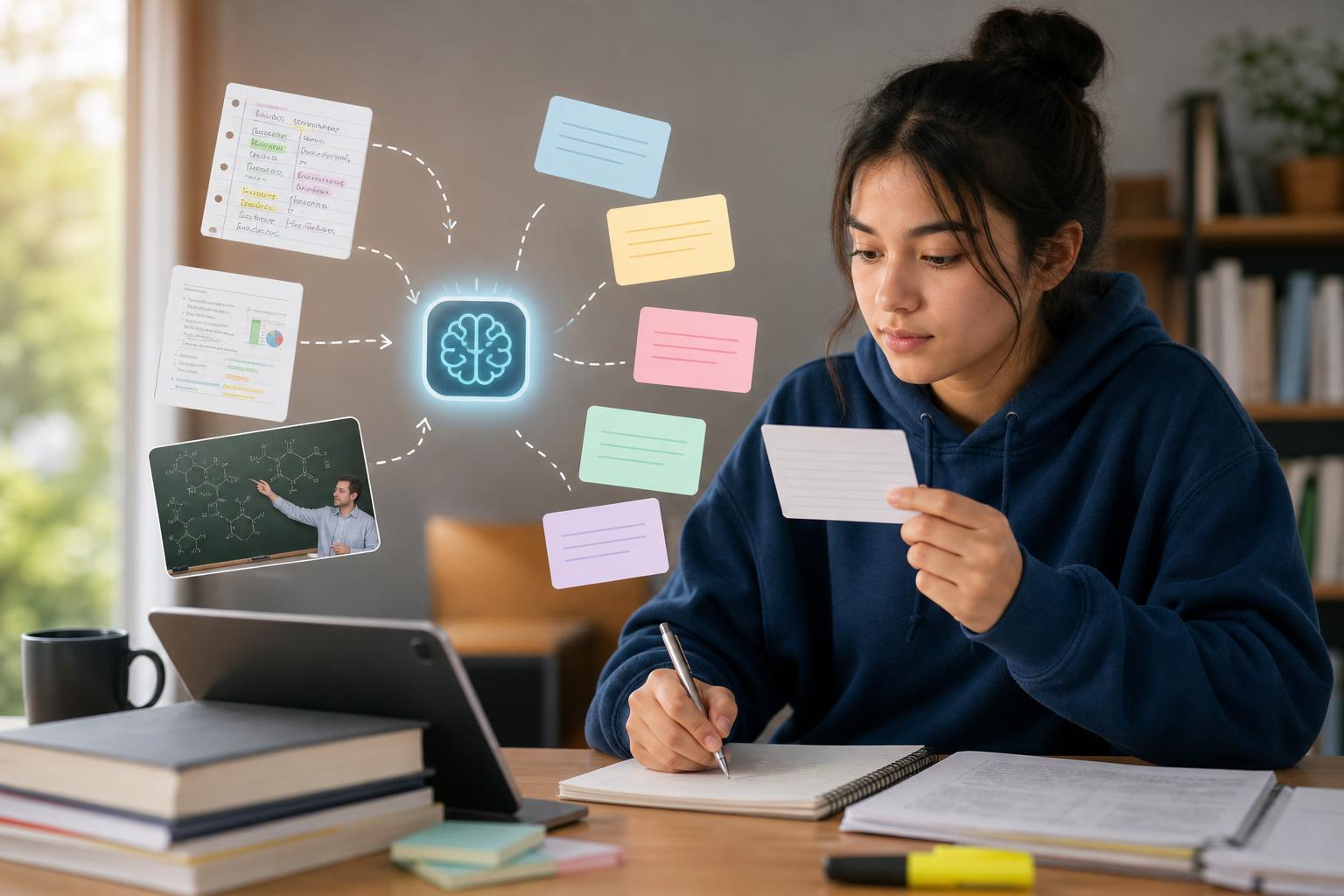
AI flashcards from class notes help students turn passive review into active recall: the process of pulling an answer from memory before checking it. Instead of rereading pages of notes and hoping the material sticks, you convert key ideas, definitions, formulas, dates, processes, and examples into question-and-answer prompts. Then you test yourself repeatedly, focus on what you miss, and space reviews over time. With AI Study Assistant, students can generate flashcards from transcripts, uploaded lessons, recordings, or lecture notes, then use those cards to build faster, more targeted study sessions.
Key takeaways
- Active recall means trying to remember the answer before looking, which strengthens memory better than rereading notes alone.
- The best flashcards are focused: one concept, definition, formula, step, example, or comparison per card.
- You can make flashcards from lecture notes, transcripts, textbook outlines, study guides, or recorded lessons.
- AI flashcard generators help students convert messy class material into review cards faster, but you should still check accuracy and edit weak cards.
- Spaced repetition makes flashcards more effective by reviewing difficult cards more often and easy cards less often.
What active recall is and why flashcards work
Active recall is a study method where you force your brain to retrieve information instead of simply recognizing it. For example, rereading the definition of photosynthesis feels familiar, but answering “What are the inputs and outputs of photosynthesis?” from memory is stronger practice. Flashcards work because they create quick retrieval moments. Each card asks a question, hides the answer, and gives you immediate feedback. This is especially useful for high school and college courses where you need to remember vocabulary, formulas, theories, timelines, processes, diagrams, and problem-solving steps.
How to turn notes into flashcards
Start by scanning your class notes for testable information. Look for headings, bold terms, professor cues like “this will be on the exam,” worked examples, cause-and-effect relationships, formulas, and lists of steps. Turn each item into a clear question. A weak card might say “Mitosis,” while a stronger card asks “What are the four main stages of mitosis in order?” Keep cards short enough to answer without reading a paragraph. If a note contains several facts, split it into multiple cards. This makes it easier to identify exactly what you know and what still needs practice.
How AI flashcards from class notes save time
An AI flashcard generator for students can quickly identify important concepts and convert them into question-and-answer cards. With AI Study Assistant, you can record a lecture, upload a lesson, import lecture notes, or use a transcript, then generate flashcards along with summaries, notes, and quizzes. This is helpful when your class material is long, messy, or spread across recordings and documents. AI can create a first draft of cards, but you should review them before studying. Delete duplicate cards, correct any unclear wording, add instructor-specific details, and mark the cards that match your upcoming exam.
A practical active recall routine for high school and college students
Use a simple three-pass routine. First, generate or create flashcards soon after class while the lesson is still fresh. Second, study by answering each card out loud or on paper before revealing the answer. Third, sort cards into “know,” “almost,” and “missed” piles. Review missed cards again the same day, then revisit them after one day, three days, one week, and before the exam. For problem-based courses like math, chemistry, economics, or physics, include cards that ask for the next step in a solution, not just definitions. For reading-heavy courses, include comparison, significance, and example cards.
Best practices for better AI-generated flashcards
When you make flashcards from lecture notes or study flashcards from transcripts, aim for quality over quantity. Each card should test one idea. Use specific prompts such as “What is the difference between X and Y?” or “Why does this process matter?” Avoid cards that are too broad, such as “Explain World War I.” Instead, break broad topics into causes, alliances, major events, turning points, and consequences. Add examples from your teacher or professor because exam questions often reflect class emphasis. Finally, mix card types: definitions, short answers, fill-in-the-blank, compare-and-contrast, process order, and application questions.
Flashcards
What does active recall mean?
Active recall means trying to retrieve information from memory before checking the answer.
Why are flashcards useful for studying class notes?
Flashcards turn notes into quick questions that force retrieval practice and reveal what you do not know yet.
What is one rule for writing a strong flashcard?
A strong flashcard should test one clear idea at a time.
What types of class material can be turned into AI flashcards?
Lecture notes, transcripts, recordings, uploaded lessons, textbook outlines, and study guides can be turned into AI flashcards.
Why should students review AI-generated flashcards before studying?
Students should check AI-generated cards for accuracy, clarity, duplicates, and alignment with what the teacher emphasized.
What is spaced repetition?
Spaced repetition is reviewing material over increasing time intervals so information is strengthened before it is forgotten.
What should you do with flashcards you miss?
You should review missed flashcards more often and identify the part of the concept that caused confusion.
Why is rereading notes usually less effective than active recall?
Rereading can create familiarity without proving you can retrieve the information on your own.
What is a good flashcard format for a process?
A good process card asks for the steps in order or asks what happens at a specific step.
How can AI Study Assistant help with flashcard creation?
AI Study Assistant can generate flashcards from transcripts, uploaded lessons, recordings, or lecture notes.
Quiz
1. What is the main purpose of using AI flashcards from class notes?
- A. To replace attending class
- B. To practice retrieving information from memory
- C. To make notes longer
- D. To avoid reviewing difficult topics
Show answer
Answer: To practice retrieving information from memory
Flashcards are most effective when they support active recall, which means answering from memory before checking the answer.
2. Which flashcard is most effective?
- A. Chapter 5
- B. Everything about cell division
- C. What are the stages of mitosis in order?
- D. Read the mitosis section again
Show answer
Answer: What are the stages of mitosis in order?
This card asks a specific, answerable question and tests one focused concept.
3. What should you do after generating flashcards with AI?
- A. Study them without checking
- B. Delete all difficult cards
- C. Review and edit them for accuracy
- D. Only use the first five cards
Show answer
Answer: Review and edit them for accuracy
AI can create a helpful first draft, but students should check wording, correctness, duplicates, and course relevance.
4. Which study schedule best reflects spaced repetition?
- A. Review once the night before the test
- B. Review missed cards today, tomorrow, in three days, and next week
- C. Read all notes for six hours in one sitting
- D. Only review cards you already know
Show answer
Answer: Review missed cards today, tomorrow, in three days, and next week
Spaced repetition uses multiple review sessions over time, with more attention on weaker material.
5. Which source can AI Study Assistant use to create study flashcards?
- A. Only handwritten exams
- B. Only published textbooks
- C. Transcripts, uploaded lessons, recordings, or lecture notes
- D. Only multiple-choice answer keys
Show answer
Answer: Transcripts, uploaded lessons, recordings, or lecture notes
AI Study Assistant is designed to work from your own class material, including recordings, transcripts, uploaded lessons, and notes.
FAQs
Can AI make flashcards from lecture notes?
Yes. An AI flashcard generator for students can turn lecture notes into question-and-answer cards. For best results, organize your notes by topic, include headings, and review the generated cards for accuracy before studying.
Are AI flashcards better than making flashcards by hand?
AI flashcards are faster and useful for creating a first draft from long notes or transcripts. Hand editing is still important because rewriting unclear cards, adding class-specific examples, and removing duplicates makes the deck more effective.
How many flashcards should I study at once?
Start with a focused set of 15 to 30 cards for one topic or chapter. If you have more, divide them into smaller study sessions and prioritize missed cards rather than trying to review everything equally.
Can I use flashcards for subjects like math or chemistry?
Yes, but include more than definitions. Create cards for formulas, when to use each formula, common mistakes, units, steps in a solution, and short practice prompts that ask you to identify the next step.
Next step
Turn this topic into a study session with notes, flashcards, and a practice quiz built from your own class material.

Leave a Reply