
Listen to this article
Photosynthesis Study Guide
This photosynthesis study guide gives students a clear, practical overview of how plants, algae, and some bacteria convert light energy into chemical energy. You’ll review the purpose of photosynthesis, the main equation, the two major stages, important structures like chloroplasts, and the factors that affect the rate of the process. Whether you need photosynthesis notes for class, a photosynthesis summary for test prep, or photosynthesis flashcards and a quiz for review, this guide is designed to help you understand both the big picture and the core vocabulary.
Key takeaways
- Photosynthesis converts light energy into chemical energy stored in glucose.
- The process mainly occurs in chloroplasts, especially in the thylakoids and stroma.
- Photosynthesis has two main stages: the light-dependent reactions and the Calvin cycle.
- Water, carbon dioxide, light intensity, and temperature all influence the rate of photosynthesis.
- Oxygen released during photosynthesis comes from the splitting of water molecules in the light reactions.
What Is Photosynthesis?
Photosynthesis is the biological process by which plants, algae, and some bacteria use sunlight to make food. In most school-level biology courses, photosynthesis is summarized by the equation: 6CO2 + 6H2O + light energy -> C6H12O6 + 6O2. This means carbon dioxide and water are used to produce glucose and oxygen. The glucose stores chemical energy that organisms can later use in cellular respiration. Photosynthesis is essential because it provides the base of many food chains and adds oxygen to Earth’s atmosphere.
Where Photosynthesis Happens
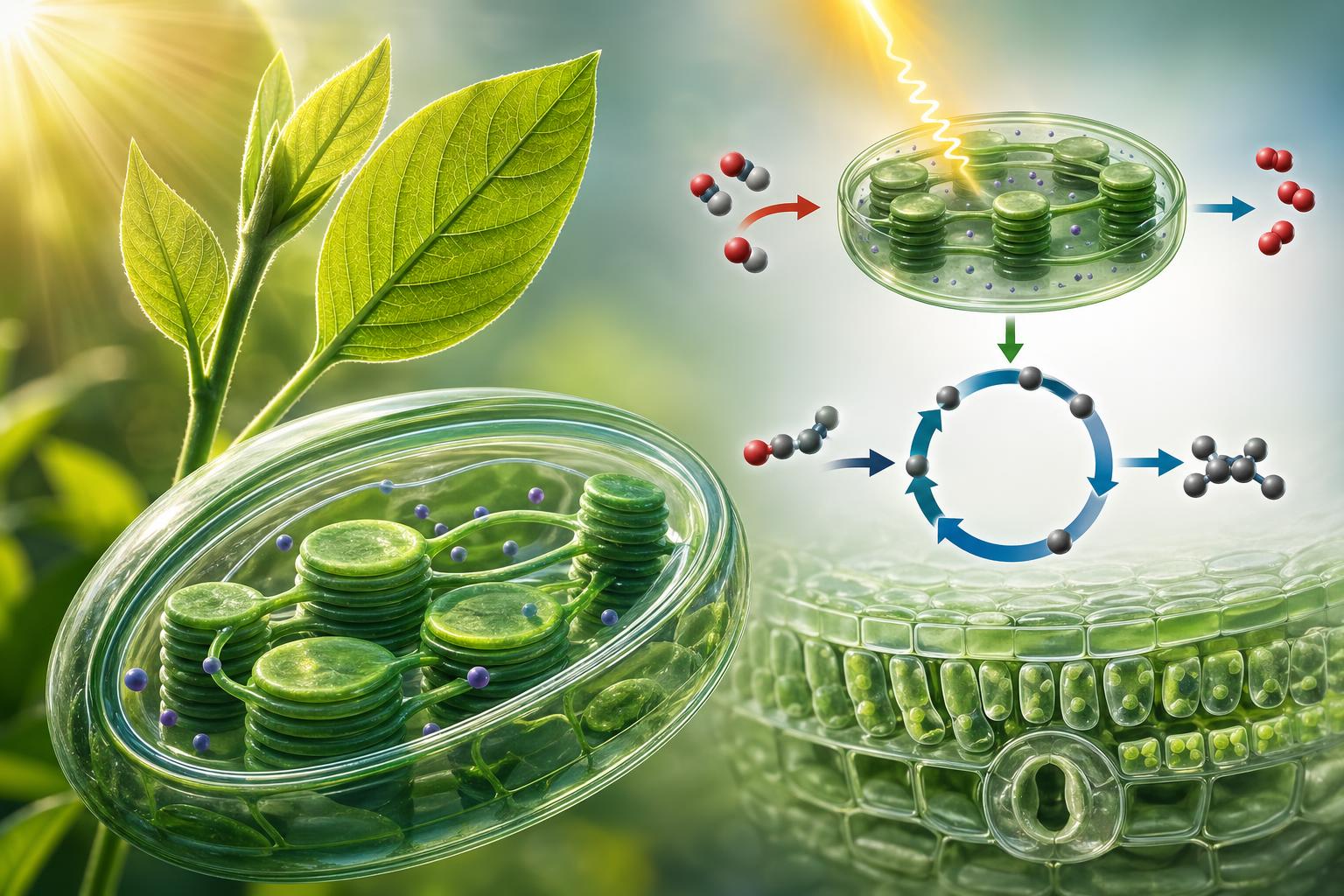
In plants, photosynthesis occurs mainly in the chloroplasts, which are organelles found most abundantly in leaf cells. Inside a chloroplast are stacks of membrane sacs called thylakoids, which contain chlorophyll and other pigments that absorb light. The fluid-filled area surrounding the thylakoids is called the stroma. The light-dependent reactions take place in the thylakoid membranes, while the Calvin cycle takes place in the stroma. Leaves are adapted for photosynthesis because they have a broad surface area, stomata for gas exchange, and veins to transport water and sugars.
The Two Stages of Photosynthesis
Photosynthesis is usually divided into two connected stages. First, the light-dependent reactions capture sunlight in the thylakoid membranes. During these reactions, water is split, oxygen is released, and energy carriers ATP and NADPH are produced. Second, the Calvin cycle uses carbon dioxide along with ATP and NADPH in the stroma to build sugars. The Calvin cycle does not directly require light, but it depends on the products of the light reactions. Together, these stages allow plants to transform solar energy into usable chemical energy.
Factors That Affect Photosynthesis
Several environmental factors influence the rate of photosynthesis. Light intensity usually increases the rate up to a certain point, because more energy is available for the light-dependent reactions. Carbon dioxide concentration can also raise the rate until another factor becomes limiting. Temperature affects enzyme activity, especially in the Calvin cycle, so rates often rise to an optimum and then fall if temperatures become too high. Water availability matters because water is a reactant, and low water levels can cause stomata to close, reducing carbon dioxide intake. Chlorophyll content and leaf health also affect how efficiently light is absorbed.
Why Photosynthesis Matters
Photosynthesis is one of the most important processes in biology because it links the Sun’s energy to life on Earth. Autotrophs use it to produce organic molecules that support their own growth and feed consumers either directly or indirectly. It also plays a major role in the carbon cycle by removing carbon dioxide from the atmosphere and storing carbon in biomass. In addition, the oxygen produced by photosynthesis supports aerobic respiration in many organisms. Understanding photosynthesis helps students connect topics like ecosystems, energy transfer, plant structure, and cellular respiration.
Flashcards
What is the overall purpose of photosynthesis?
To convert light energy into chemical energy stored in glucose.
What organelle carries out photosynthesis in plant cells?
The chloroplast.
Where do the light-dependent reactions occur?
In the thylakoid membranes.
Where does the Calvin cycle occur?
In the stroma of the chloroplast.
What gas is taken in during photosynthesis?
Carbon dioxide.
What gas is released during photosynthesis?
Oxygen.
What molecule absorbs light energy for photosynthesis?
Chlorophyll.
What are the main energy-carrying products of the light reactions?
ATP and NADPH.
Quiz
1. Which of the following is the main pigment involved in photosynthesis?
- A. Chlorophyll
- B. Hemoglobin
- C. Keratin
- D. Insulin
Show answer
Answer: Chlorophyll
Chlorophyll is the primary pigment that absorbs light energy for photosynthesis, especially in the blue and red parts of the spectrum.
2. In which part of the chloroplast does the Calvin cycle take place?
- A. Stroma
- B. Thylakoid membrane
- C. Nucleus
- D. Ribosome
Show answer
Answer: Stroma
The Calvin cycle occurs in the stroma, where carbon dioxide is used to build sugars with the help of ATP and NADPH.
3. What is produced when water is split during the light-dependent reactions?
- A. Oxygen
- B. Nitrogen
- C. Glucose
- D. Carbon dioxide
Show answer
Answer: Oxygen
Water splitting, also called photolysis, releases oxygen, electrons, and hydrogen ions during the light reactions.
4. Which factor can directly limit the rate of photosynthesis?
- A. Carbon dioxide concentration
- B. Blood type
- C. Bone density
- D. Muscle mass
Show answer
Answer: Carbon dioxide concentration
Carbon dioxide concentration is a classic limiting factor because it is a reactant needed in the Calvin cycle.
5. What is the main function of ATP and NADPH in photosynthesis?
- A. To provide energy and reducing power for sugar production
- B. To break down glucose during digestion
- C. To store oxygen in leaf tissues
- D. To transport water from roots to flowers
Show answer
Answer: To provide energy and reducing power for sugar production
ATP supplies energy and NADPH supplies high-energy electrons used in the Calvin cycle to help produce sugars.
FAQs
What is a simple photosynthesis summary?
Photosynthesis is the process by which plants use sunlight, water, and carbon dioxide to make glucose and release oxygen. It includes light-dependent reactions that capture energy and a Calvin cycle that builds sugars.
Why is photosynthesis important for students to understand in biology?
Photosynthesis connects major biology ideas such as energy conversion, plant cell structure, ecosystems, the carbon cycle, and the relationship between producers and consumers.
What is the difference between photosynthesis and cellular respiration?
Photosynthesis stores energy by making glucose from carbon dioxide and water using light, while cellular respiration releases energy by breaking down glucose, usually with oxygen, to make ATP.
Study Smarter with AI
Use AI Study Assistant to turn this photosynthesis study guide into personalized notes, quick reviews, flashcards, and targeted practice before your next biology quiz or exam.

Leave a Reply