Listen to this article
AI Flashcards From Lecture Notes: Are They Better Than Making Your Own?
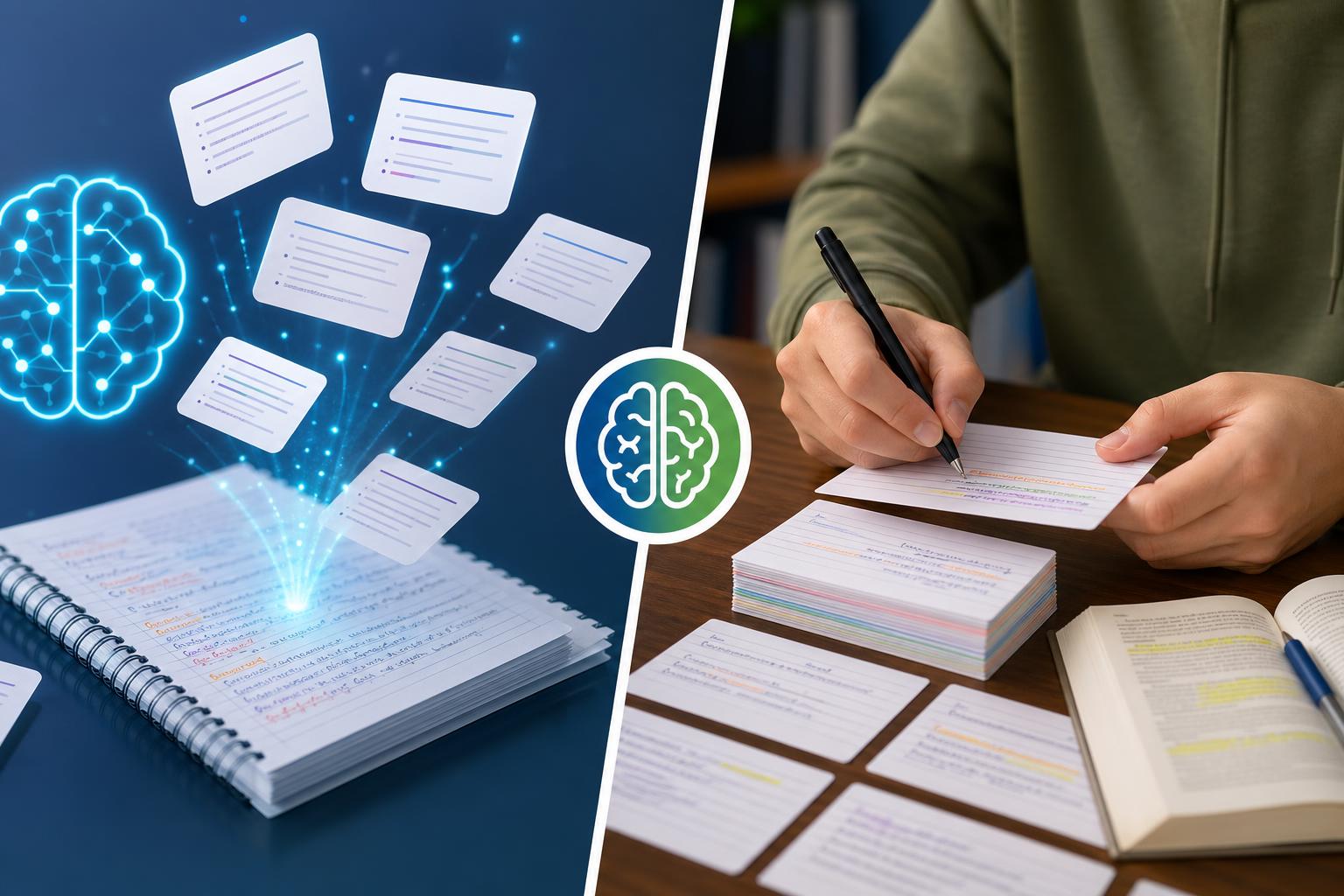
AI flashcards from lecture notes can be a faster and more scalable way to review class material than building every card manually, especially for high school and college students managing multiple subjects. The tradeoff is that speed does not always equal deeper processing. Manually writing cards often strengthens understanding during creation, while automatic flashcards from notes can save major prep time and quickly turn lectures into review sets. For most students, the best approach is not choosing one method forever, but using AI to generate a first draft from class notes and then editing, tagging, and practicing the cards strategically for stronger recall.
Key takeaways
- AI flashcards from lecture notes usually save significant time compared with building decks entirely by hand.
- Manual card creation can improve understanding because students must decide what matters and how to phrase it.
- The strongest workflow for many students is hybrid: generate cards with AI, then revise weak, vague, or overly broad cards yourself.
- AI works best when lecture notes are clear, organized, and detailed enough to produce accurate question-answer pairs.
- For exam prep, the best flashcards for lecture review are concise, specific, and focused on one fact, concept, or relationship per card.
AI flashcards from lecture notes vs making your own: the core comparison
The main difference between AI-generated and manual flashcards is where the mental effort happens. With manual decks, students spend time selecting important ideas, simplifying definitions, and turning notes into prompts. That process can strengthen learning before review even begins. With ai flashcards from lecture notes, the system does much of the extraction and formatting work for you, which can dramatically reduce setup time. This matters when you have several classes, long lectures, or limited study hours. For high school and college students, the choice often depends on your goal. If your biggest problem is that you never get around to making cards, automatic flashcards from notes may be far better than no flashcards at all. If your goal is mastering difficult material like biology pathways, historical causation, or math vocabulary with precision, manual creation may produce better first-pass understanding. In practice, students comparing manual vs ai flashcards should measure both time saved and quality of recall, not just convenience.
When AI flashcards from lecture notes are better
AI-generated cards tend to win in speed, volume, and consistency. If you need to make flashcards from class notes after every lecture, AI can quickly convert raw notes into a usable review deck. This is especially helpful for content-heavy courses where you need broad coverage, such as AP history, introductory psychology, anatomy, or survey science classes. AI is often the better choice when your notes are already well structured with headings, bullet points, examples, and key terms. In those cases, the system can identify likely definitions, processes, comparisons, and cause-effect relationships. Students who struggle with procrastination may also benefit because AI removes the friction of starting. Instead of spending an hour building cards, you can begin studying in minutes. Another advantage is iteration. If the first deck is too basic, students can refine the notes, regenerate cards, and keep improving the set. This makes it easier to study smarter with lecture flashcards because preparation becomes less of a barrier. For weekly quizzes or cumulative finals, faster deck creation can mean more time spent on actual retrieval practice.
When making your own flashcards is better
Manual flashcard creation is usually stronger for deep processing. When you write your own prompt, you decide what the real question is, what wording will trigger memory effectively, and what details belong on the back. That act of transforming notes into learning prompts can improve comprehension and expose confusion early. Making your own cards is often best when the lecture is messy, your notes are incomplete, or the topic requires judgment rather than simple recall. For example, literature themes, historical interpretation, lab reasoning, and multi-step problem solving often need carefully tailored cards. AI may produce cards that are too generic, too obvious, or too broad. Students may then review a deck that feels productive but does not match the actual exam. Manual creation also helps students personalize flashcards. You can include your teacher's phrasing, likely test traps, class examples, diagrams, mnemonics, and confusing contrasts. That personalization can make review more memorable than a generic deck. So while manual prep takes longer, it may produce better recall for difficult or highly specific material.
The best method for most students: use AI first, then edit intentionally
For many learners, the best answer is a hybrid system. Start with ai flashcards from lecture notes to save time, then improve the cards using what you know from class. Delete duplicates, split overloaded cards into smaller ones, rewrite vague prompts, and add examples your teacher emphasized. This keeps the efficiency of automatic flashcards from notes while preserving the learning benefits of active processing. A practical workflow looks like this: take organized lecture notes, generate a deck, review each card for accuracy, convert weak cards into clearer prompts, and then study with spaced repetition and self-testing. If a card can be answered through guessing, rewrite it. If a card contains too many facts at once, split it. If an important lecture point is missing, add it manually. This approach is often the best flashcards for lecture review because it balances speed, accuracy, and memory strength. Students who want to study smarter with lecture flashcards should remember that flashcard quality matters more than how the first draft was made. AI can speed up preparation, but recall improves most when students actively refine and repeatedly retrieve the material.
Flashcards
What is the main advantage of AI flashcards from lecture notes?
They save time by quickly turning notes into review cards.
What is a key benefit of making flashcards manually?
Manual creation can deepen understanding because you must process and rephrase the material.
When are automatic flashcards from notes most useful?
They are most useful when notes are clear, organized, and content-heavy.
What is a common weakness of AI-generated flashcards?
They can be too vague, too broad, or miss instructor-specific emphasis.
What study method combines speed and deeper learning?
Generate cards with AI first, then edit and personalize them manually.
Why should students review AI-generated cards before studying them?
To check for accuracy, clarity, missing details, and poor card design.
What makes a flashcard effective for lecture review?
It should test one clear idea, fact, term, or relationship at a time.
How can students make AI flashcards better for exams?
By adding class examples, teacher wording, and likely test points to the deck.
Quiz
1. Which factor most strongly favors using AI flashcards from lecture notes?
- A. You want to spend more time formatting cards by hand
- B. You need to create review cards quickly for multiple classes
- C. You only study subjects that never use lecture notes
- D. You want to avoid reviewing the cards after they are made
Show answer
Answer: You need to create review cards quickly for multiple classes
AI is most helpful when speed and scale matter, especially across several courses with frequent lectures.
2. What is the main learning benefit of making flashcards yourself?
- A. It removes the need to understand the notes
- B. It guarantees perfect recall after one session
- C. It forces active processing of the material while creating cards
- D. It works only for easy vocabulary lists
Show answer
Answer: It forces active processing of the material while creating cards
Manual card writing requires selecting key ideas and rephrasing them, which can strengthen comprehension before review begins.
3. Which situation is best suited for automatic flashcards from notes?
- A. Your notes are organized and include clear key points
- B. Your notes contain almost no usable information
- C. Your class grade depends only on essays with no factual recall
- D. Your goal is to avoid editing weak cards
Show answer
Answer: Your notes are organized and include clear key points
AI performs best when source notes are structured well enough to produce accurate, targeted prompts.
4. Why might a student prefer manual over AI flashcards for a difficult class?
- A. Manual cards always take less time
- B. Manual cards can be tailored to nuanced concepts and teacher emphasis
- C. AI cards cannot be studied more than once
- D. AI cards are never useful for review
Show answer
Answer: Manual cards can be tailored to nuanced concepts and teacher emphasis
For complex or instructor-specific material, manually designed cards can better match what the student actually needs to remember.
5. What is the strongest overall strategy for most students comparing manual vs ai flashcards?
- A. Use AI to generate a deck and then revise it carefully
- B. Avoid flashcards and only reread notes
- C. Make every card by hand no matter the workload
- D. Use the first AI deck without checking accuracy
Show answer
Answer: Use AI to generate a deck and then revise it carefully
A hybrid method preserves the time savings of AI while improving card quality through student editing and personalization.
FAQs
Do AI flashcards from lecture notes actually improve memory?
They can improve memory if students actively review them with retrieval practice and spaced repetition. AI mainly saves preparation time. Memory gains depend on card quality, how often you practice, and whether you refine the deck instead of passively reading it.
Are AI-generated flashcards good enough for finals?
They can be a strong starting point for finals, especially in content-heavy courses, but students should not assume the first generated deck is complete. For major exams, review the cards for accuracy, add missing lecture details, and align the deck with the teacher's emphasis and likely test format.
Should high school and college students stop making flashcards manually?
Not necessarily. Manual flashcards are still valuable for hard topics, weak notes, and classes where wording, examples, or reasoning matter. Many students do best by using AI for the first draft and manual editing for the final deck.
Build smarter lecture flashcards
Turn your class notes into study-ready flashcards faster, then edit and review them for stronger recall. AI Study Assistant helps you save prep time without giving up control over card quality.
Related guides
- How to create flashcards from a lecture
- Best AI tools for studying from lectures
- AI flashcards from lectures
- Create flashcards from lecture notes
- Best AI lecture summarizer for students
- AI lecture note taker vs manual notes
- How to study from a long lecture without rewatching
- Best AI study tools for college students

Leave a Reply