Listen to this article
AI Lecture Note Taker vs. Manual Notes: Which Is Better for Students?
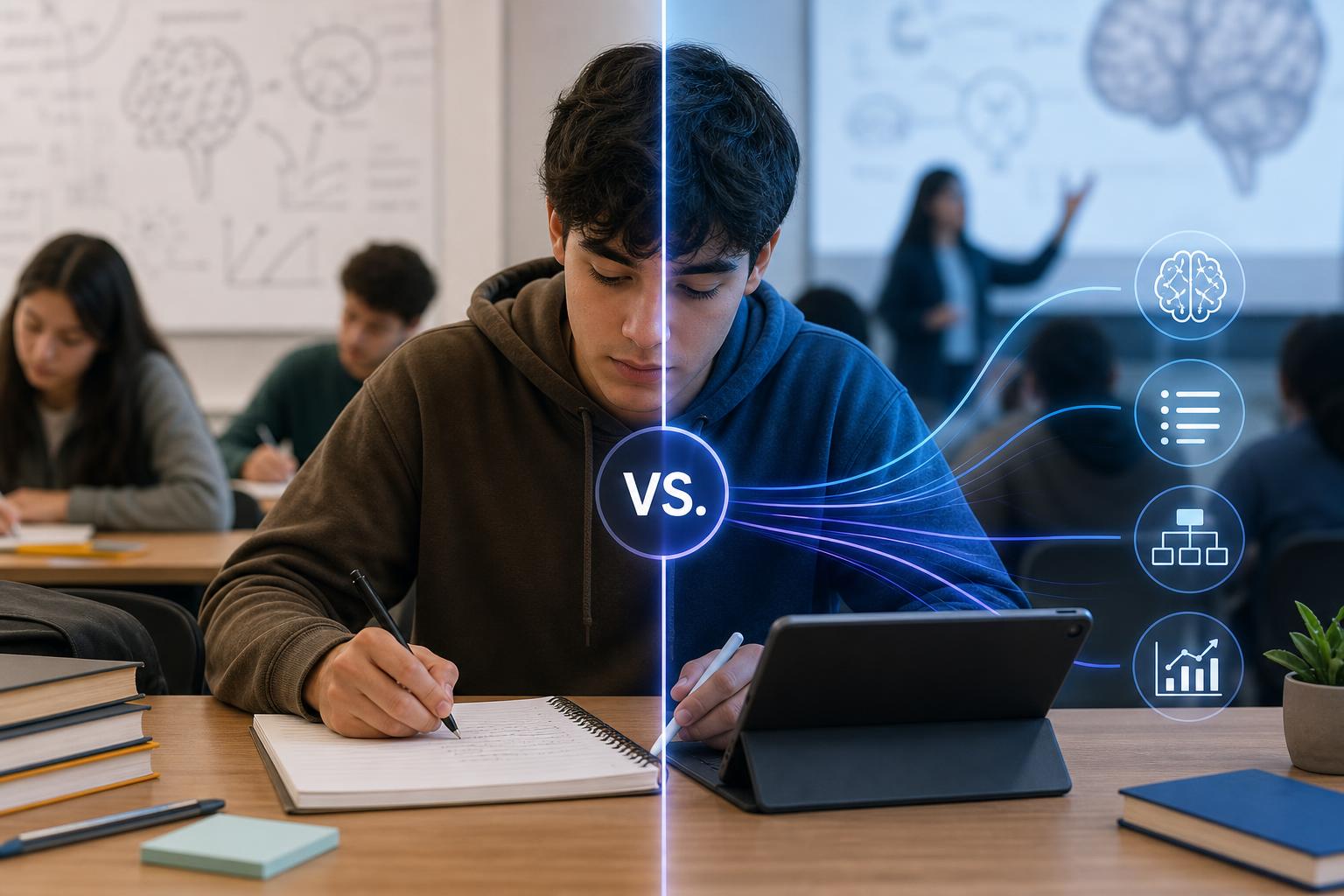
When comparing an AI lecture note taker vs manual notes, neither method is automatically better for every student or class. AI tools are useful for capturing detailed lecture content quickly, creating searchable transcripts, and organizing material into summaries, flashcards, and quizzes. Handwritten or typed notes require more active selection and processing, which can support attention and understanding. For many high school and college students, the best approach is a hybrid one: listen actively and record key ideas manually, then use AI-generated materials to fill gaps, organize the lesson, and prepare for review. AI should supplement your learning—not replace participation, critical thinking, or checking the source material.
Key takeaways
- AI lecture note takers can capture more detail and generate organized study materials faster than manual note-taking alone.
- Manual notes encourage students to select, paraphrase, and connect ideas during class, supporting active engagement.
- AI transcripts and automatic lecture notes can contain errors, especially when audio is unclear or speakers use specialized vocabulary.
- The best note-taking method for lectures is often a hybrid workflow that combines brief manual notes with an AI-assisted transcript and review materials.
- Students should verify important definitions, formulas, dates, quotations, and assignment instructions against reliable class sources.
- Always follow school policies and obtain permission before recording a teacher, professor, class discussion, or other students.
AI Notes vs. Handwritten Notes at a Glance
An AI lecture note taker records or processes lesson audio, creates a transcript, and may transform the content into summaries, structured notes, flashcards, or quizzes. Manual note-taking means selecting and recording information yourself, either by handwriting or typing. AI-assisted notes are strongest when coverage, speed, searchability, and organization matter. Manual notes are strongest when the goal is to process ideas actively while listening. Handwriting can also reduce the temptation to transcribe every sentence because it is slower than typing, encouraging students to summarize. Typed notes are faster and easier to reorganize, but they can become passive if the student copies without thinking. The right choice depends on the course, lecture format, accessibility needs, teacher policies, and how the student studies afterward. A fast, information-dense college lecture may benefit from automatic lecture notes, while a discussion-based seminar may call for a few manual observations and questions rather than a full transcript.
Accuracy, Detail, and the Risk of Missing Information
AI note takers can capture far more spoken detail than most students can write during a live lesson. This is useful when a teacher moves quickly, explains a complicated process, or provides examples that are not included on the slides. A searchable transcript also makes it easier to locate a term or revisit the context around an assignment. However, speech recognition is not perfect. Background noise, quiet speakers, overlapping discussion, accents, poor microphones, equations, and subject-specific terms can all cause transcription mistakes. An AI-generated summary may also omit a detail that matters for your course. Students should check important information against the recording, slides, textbook, teacher-provided materials, or their own notes. Manual notes contain fewer words, but those words may better reflect what the student recognized as important. They can still be inaccurate if the student mishears a term, copies a formula incorrectly, or misses content while writing. For high-stakes details, both methods require verification.
Attention and Retention During Lectures
Manual note-taking requires students to decide what matters, translate it into their own words, and connect it with prior knowledge. Those actions can promote deeper processing. Useful manual notes often include questions, examples, diagrams, points of confusion, and links to earlier lessons—not just copied sentences. An AI note taker for students can reduce the pressure to capture every word, making it easier to listen to the explanation. But it can also encourage disengagement if a student assumes the transcript will do all the learning later. Recording a lecture is not the same as understanding it, and reading an AI summary once is rarely enough for durable learning. To stay active while using AI, write down the lecture's main claims, mark confusing moments, attempt example problems, and answer the teacher's questions. After class, compare your understanding with the generated transcript and summary. Then retrieve the information through flashcards, practice questions, or explaining the topic without looking at your notes.
Speed, Organization, and Study Efficiency
AI-assisted tools can turn a lesson into review materials much faster than creating everything manually. A student can search the transcript, review a concise summary, identify key concepts, and practice with generated flashcards or quizzes. This can be especially helpful when managing several courses or catching up after an approved absence. Manual notes take more effort to create and clean up, but that effort can be part of learning. Well-structured manual notes—such as an outline, concept map, Cornell notes page, or worked-example sheet—can reveal relationships that a generic transcript does not emphasize. For efficient studying, avoid treating a complete transcript as the final study guide. Condense it into a manageable set of ideas. Organize material by learning objective, topic, process, or likely assessment type. AI Study Assistant can help turn uploaded or recorded lessons into transcripts, summaries, notes, flashcards, and quizzes, while the student remains responsible for checking accuracy and practicing retrieval.
When Each Note-Taking Method Works Best
AI-assisted note-taking is well suited to fast lectures, content-heavy classes, revision after class, accessibility support, and lessons containing detailed verbal explanations. It can also help students who struggle to listen and write simultaneously. Recording should only occur when it is allowed by the instructor, institution, and applicable privacy rules. Manual note-taking is often better for problem-solving classes, discussions, laboratories, and lessons where diagrams or instructor emphasis matter more than a word-for-word record. In mathematics and science courses, students may benefit more from writing each reasoning step than from reading a transcript of the explanation. In literature or social science discussions, recording personal interpretations and questions can be more useful than capturing every comment. A hybrid method is especially effective when you need both coverage and active engagement. Keep short manual notes during class, including main ideas, questions, formulas, and timestamps. After class, use the AI-generated materials to recover missing details, correct misunderstandings, and create targeted practice.
A Practical Hybrid Workflow for Students
Before class, check whether recording is permitted and prepare the lecture title, date, and learning objectives. If using AI Study Assistant, begin with a clear audio source or upload an allowed recording after class. During the lesson, focus on listening rather than transcribing every sentence. Manually record the central argument, key terms, worked examples, teacher emphasis, and anything you do not understand. Add a timestamp when you want to revisit a specific explanation. After class, review the transcript while the lesson is still fresh. Correct names, technical vocabulary, equations, and other obvious errors. Compare the generated summary with your course objectives and slides, then add anything important that is missing. Finally, study actively. Edit flashcards so they test one clear idea at a time, complete a practice quiz without looking at the notes, and revisit weak areas in the transcript or textbook. This workflow combines the coverage of automatic lecture notes with the cognitive benefits of manual processing and retrieval practice.
Flashcards
What is the main advantage of an AI lecture note taker during a fast lecture?
It can capture and organize more spoken detail than most students can write manually in real time.
Why can manual note-taking support comprehension?
It requires the student to select, paraphrase, organize, and connect ideas while listening.
What is a major limitation of automatic lecture notes?
Transcripts and summaries may misinterpret speech or omit important course-specific details.
What is passive transcription?
It is copying words without actively evaluating, paraphrasing, or connecting their meaning.
What should students verify in AI-generated lecture notes?
They should verify important definitions, formulas, names, dates, quotations, and assignment instructions.
What is a hybrid note-taking method?
It combines brief, active manual notes during class with AI-generated transcripts and study materials after class.
How can a student remain engaged while an AI tool records a lecture?
The student can identify main ideas, write questions, attempt examples, and mark confusing moments.
Why is a full lecture transcript not always an effective study guide?
It may be too long and unprioritized, so students still need to condense, organize, and practice retrieving the material.
When may manual notes be preferable to a transcript?
They may be preferable during problem-solving, diagram-heavy, laboratory, or discussion-based lessons.
What should a student do before recording a class?
Check the instructor's rules, school policies, consent requirements, and applicable privacy expectations.
Quiz
1. Which approach best combines detailed coverage with active engagement?
- A. Rely only on an unedited transcript
- B. Copy every slide word for word
- C. Take brief manual notes and review an AI transcript afterward
- D. Skip the lecture and read the summary
Show answer
Answer: Take brief manual notes and review an AI transcript afterward
A hybrid workflow preserves the benefits of active listening while using AI to recover details and create review materials.
2. Which factor is most likely to reduce the accuracy of automatic lecture notes?
- A. Clear audio from one speaker
- B. Background noise and overlapping speech
- C. A quiet classroom
- D. Reviewing the transcript after class
Show answer
Answer: Background noise and overlapping speech
Noise and simultaneous speakers make it harder for speech recognition systems to distinguish words accurately.
3. Why can manual note-taking improve learning during class?
- A. It guarantees every detail is recorded
- B. It removes the need to study later
- C. It requires students to process and select information
- D. It always produces a searchable transcript
Show answer
Answer: It requires students to process and select information
Selecting, paraphrasing, and organizing ideas can promote more active processing than copying everything verbatim.
4. What is the best response to a technical term that appears incorrectly in an AI transcript?
- A. Memorize the transcript version
- B. Delete the entire set of notes
- C. Check the term against reliable course materials
- D. Assume the term is unimportant
Show answer
Answer: Check the term against reliable course materials
Students should verify specialized vocabulary using slides, textbooks, recordings, or instructor-provided resources.
5. Which use of an AI lecture note taker is least likely to support learning?
- A. Creating flashcards from a reviewed transcript
- B. Using the transcript to revisit a confusing explanation
- C. Assuming the generated summary replaces attention and practice
- D. Comparing generated notes with course objectives
Show answer
Answer: Assuming the generated summary replaces attention and practice
AI-generated materials are study supports, not substitutes for listening, thinking, verification, and retrieval practice.
6. What should a student do first before recording a lecture?
- A. Share the recording publicly
- B. Confirm that recording is permitted
- C. Turn the entire transcript into flashcards
- D. Delete all manual notes
Show answer
Answer: Confirm that recording is permitted
Instructor rules, institutional policies, consent, and privacy requirements should be checked before recording.
FAQs
Is an AI lecture note taker better than handwritten notes?
It depends on the learning task. AI is better for capturing detail, searching a transcript, and creating organized review materials quickly. Handwritten notes can encourage active selection and paraphrasing. Many students benefit most from combining brief handwritten notes with a reviewed AI transcript.
Can I rely on automatic lecture notes for an exam?
Automatic lecture notes should not be your only source. Check important concepts against the recording, slides, textbook, and instructor materials. Then use active methods such as practice questions, recall, problem-solving, and spaced flashcard review.
Does using an AI note taker reduce attention in class?
It can if you stop participating because you expect the tool to capture everything. It may improve attention if it reduces the pressure to transcribe every sentence while you continue identifying main ideas, asking questions, and working through examples.
Are typed manual notes better than handwritten notes?
Typed notes are faster, searchable, and easy to reorganize, while handwriting naturally limits how much you can copy and may encourage summarization. The better option is the one that helps you process ideas rather than transcribe passively.
Next step
Turn this topic into a study session with notes, flashcards, and a practice quiz built from your own class material.

Leave a Reply