
Listen to this article
Cell Structure Study Guide
This cell structure study guide gives students a clear overview of how cells are organized and why each part matters. In biology, understanding cell structure helps explain how organisms grow, make energy, transport materials, and maintain homeostasis. This guide reviews the major parts of prokaryotic and eukaryotic cells, summarizes the functions of key organelles, and provides cell structure notes, flashcards, and a quiz to support studying. If you are learning the basics of biology, this page is designed to help you connect cell parts to their jobs and remember the most important similarities and differences.
Key takeaways
- Cells are the basic units of life, and their structures are closely related to their functions.
- Prokaryotic cells lack a nucleus and membrane-bound organelles, while eukaryotic cells contain both.
- Major organelles such as the nucleus, mitochondria, ribosomes, endoplasmic reticulum, Golgi apparatus, and lysosomes each perform specific tasks.
- Plant cells and animal cells share many structures, but plant cells also have a cell wall, chloroplasts, and a large central vacuole.
- Review tools like an organelles summary, cell structure flashcards, and a cell structure quiz can improve retention.
What Is Cell Structure?
Cell structure refers to the parts that make up a cell and the way those parts are arranged. Every cell is surrounded by a plasma membrane that separates the inside of the cell from the external environment. Inside the cell are specialized components that help carry out life processes such as energy release, protein production, waste breakdown, and transport. Studying cell structure is important because the design of each cell part supports a specific function. For example, cells that need a lot of energy often contain many mitochondria, while cells that make proteins rely heavily on ribosomes and rough endoplasmic reticulum.
Prokaryotic and Eukaryotic Cells
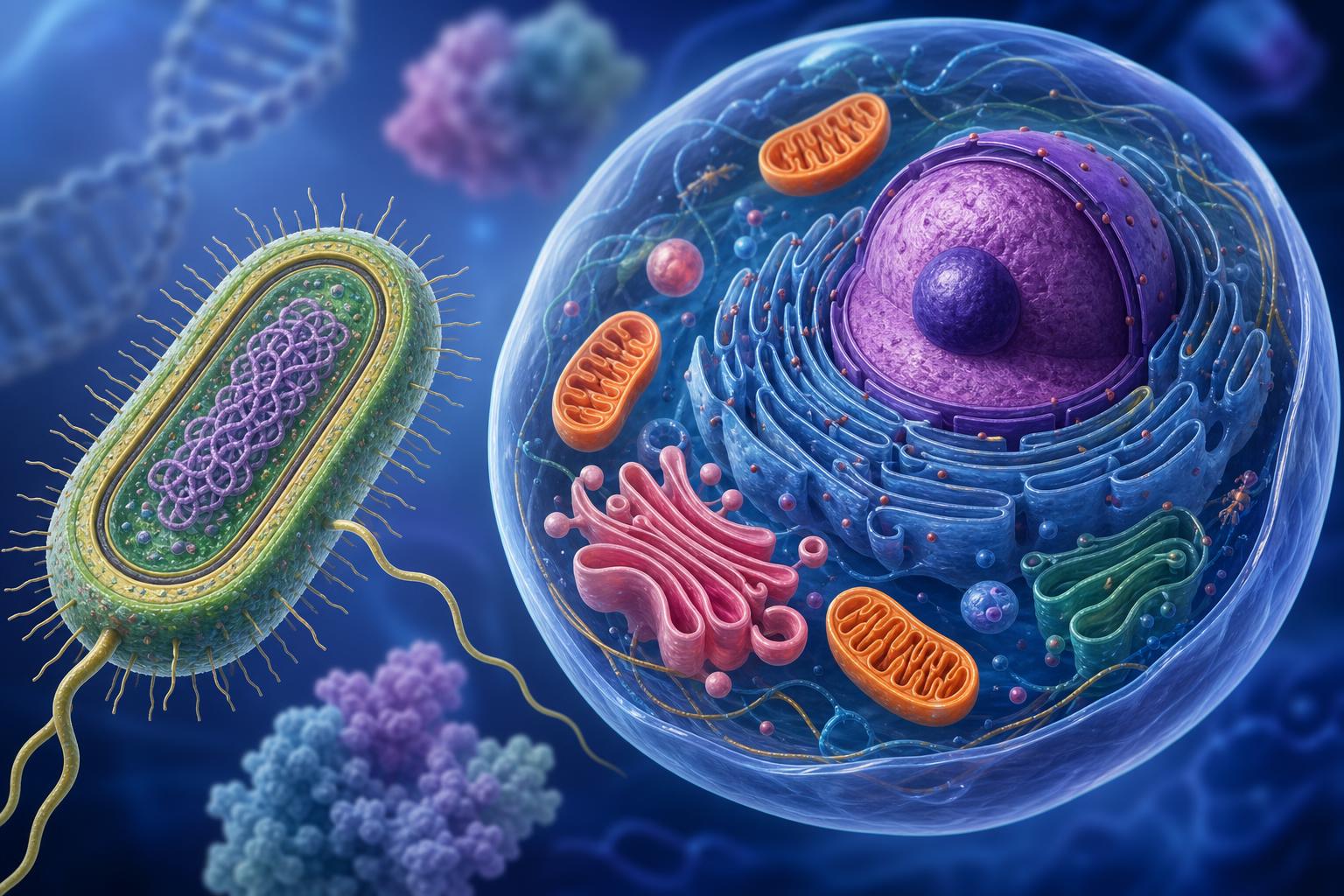
One of the most important ideas in cell structure notes is the difference between prokaryotic and eukaryotic cells. Prokaryotic cells, such as bacteria, are simpler and smaller. They do not have a true nucleus, so their DNA is located in a nucleoid region. They also lack membrane-bound organelles. Eukaryotic cells, found in plants, animals, fungi, and protists, are more complex. Their DNA is enclosed in a nucleus, and they contain membrane-bound organelles like mitochondria, the Golgi apparatus, and the endoplasmic reticulum. Both cell types have a plasma membrane, cytoplasm, ribosomes, and genetic material, but eukaryotic cells show greater internal organization.
Organelles Summary
The nucleus stores DNA and controls many cell activities. Ribosomes build proteins and may float freely in the cytoplasm or attach to rough endoplasmic reticulum. The rough endoplasmic reticulum helps process and transport proteins, while the smooth endoplasmic reticulum is involved in lipid synthesis and detoxification. The Golgi apparatus modifies, sorts, and packages molecules for transport. Mitochondria carry out cellular respiration to produce ATP, the cell’s usable energy. Lysosomes contain digestive enzymes that break down waste and worn-out cell parts. Vacuoles store water, nutrients, and waste; in plant cells, the central vacuole is especially large. Chloroplasts, found in plant cells, perform photosynthesis. The cytoskeleton helps maintain cell shape and assists with movement inside the cell.
Plant Cells vs. Animal Cells
Plant and animal cells are both eukaryotic, so they share many structures, including a nucleus, mitochondria, ribosomes, endoplasmic reticulum, Golgi apparatus, and cell membrane. However, plant cells have several structures that animal cells do not. A plant cell has a rigid cell wall outside the membrane for support and protection. It also contains chloroplasts, which capture light energy for photosynthesis, and usually has a large central vacuole that stores water and helps maintain turgor pressure. Animal cells lack cell walls and chloroplasts and often have smaller vacuoles. These differences reflect the different roles and lifestyles of plants and animals.
Flashcards
What structure controls what enters and leaves the cell?
The plasma membrane controls what enters and leaves the cell.
What organelle contains the cell’s DNA in eukaryotes?
The nucleus contains the cell’s DNA in eukaryotic cells.
Which organelle is known as the site of ATP production?
The mitochondrion is the main site of ATP production.
What do ribosomes do?
Ribosomes synthesize proteins.
What is the main function of the Golgi apparatus?
The Golgi apparatus modifies, sorts, and packages proteins and other molecules.
Which organelle performs photosynthesis in plant cells?
Chloroplasts perform photosynthesis in plant cells.
What is one major difference between prokaryotic and eukaryotic cells?
Eukaryotic cells have a nucleus, while prokaryotic cells do not.
What is the function of lysosomes?
Lysosomes break down waste materials and worn-out cell parts using enzymes.
Quiz
1. Which organelle is primarily responsible for producing ATP during cellular respiration?
- A. Nucleus
- B. Mitochondrion
- C. Golgi apparatus
- D. Lysosome
Show answer
Answer: Mitochondrion
The mitochondrion carries out cellular respiration and produces most of the cell’s ATP.
2. Which structure is found in plant cells but not animal cells?
- A. Ribosome
- B. Cell membrane
- C. Chloroplast
- D. Mitochondrion
Show answer
Answer: Chloroplast
Chloroplasts are organelles used for photosynthesis and are present in plant cells but not animal cells.
3. What is the main function of ribosomes?
- A. Store water
- B. Synthesize proteins
- C. Digest waste
- D. Control cell movement
Show answer
Answer: Synthesize proteins
Ribosomes read genetic instructions and assemble amino acids into proteins.
4. Which statement correctly describes prokaryotic cells?
- A. They contain a nucleus
- B. They have membrane-bound organelles
- C. They lack a true nucleus
- D. They are always multicellular
Show answer
Answer: They lack a true nucleus
Prokaryotic cells do not have a membrane-bound nucleus, so their DNA is found in a nucleoid region.
5. What is the role of the Golgi apparatus?
- A. Generate ATP
- B. Modify and package molecules
- C. Carry out photosynthesis
- D. Break down glucose
Show answer
Answer: Modify and package molecules
The Golgi apparatus processes, sorts, and packages proteins and lipids for transport within or out of the cell.
FAQs
Why is learning cell structure important in biology?
Learning cell structure is important because cell parts explain how organisms perform essential life functions such as making energy, building proteins, transporting materials, and maintaining balance.
What is the easiest way to remember organelle functions?
A good strategy is to group organelles by job. For example, the nucleus stores instructions, ribosomes build proteins, mitochondria release energy, and the Golgi apparatus packages materials. Using cell structure flashcards also helps reinforce memory.
How are plant and animal cells similar?
Plant and animal cells are both eukaryotic and share a nucleus, cell membrane, cytoplasm, ribosomes, mitochondria, endoplasmic reticulum, and Golgi apparatus. Their main differences involve plant-specific structures such as the cell wall and chloroplasts.
Study Smarter with AI
Turn this cell structure study guide into personalized practice with AI Study Assistant. Review organelles, generate custom quizzes, and reinforce key biology concepts faster.

Leave a Reply