
Listen to this article
Ecosystems Study Guide
An ecosystem is a community of living organisms interacting with one another and with the nonliving parts of their environment, such as water, sunlight, soil, air, and temperature. This ecosystem study guide explains the key ideas students need for general biology: how energy moves through food chains and food webs, how matter cycles through the environment, how populations interact, and how ecosystems respond to change. Use these ecosystem notes as a quick review before class, then test yourself with the ecosystem flashcards and ecosystem quiz at the end.
Key takeaways
- An ecosystem includes both biotic factors, such as plants, animals, fungi, and bacteria, and abiotic factors, such as sunlight, water, minerals, and climate.
- Energy flows through ecosystems in one direction, usually beginning with sunlight captured by producers and moving to consumers and decomposers.
- Matter is recycled through ecosystems by processes such as the water cycle, carbon cycle, nitrogen cycle, and decomposition.
- Food chains show simple feeding relationships, while food webs show the more realistic network of energy transfer in an ecosystem.
- Ecosystem stability depends on biodiversity, balanced species interactions, and the ability to recover from disturbances.
What Is an Ecosystem?
An ecosystem is made up of all the organisms in a specific area plus the physical environment they interact with. The living parts are called biotic factors and include producers, consumers, decomposers, predators, prey, parasites, and competitors. The nonliving parts are called abiotic factors and include sunlight, temperature, rainfall, soil type, oxygen, carbon dioxide, salinity, and pH. Ecosystems can be small, such as a pond or rotting log, or very large, such as a forest, coral reef, desert, or ocean. The boundaries of an ecosystem are often defined by what a scientist wants to study.
Energy Flow: Producers, Consumers, and Decomposers
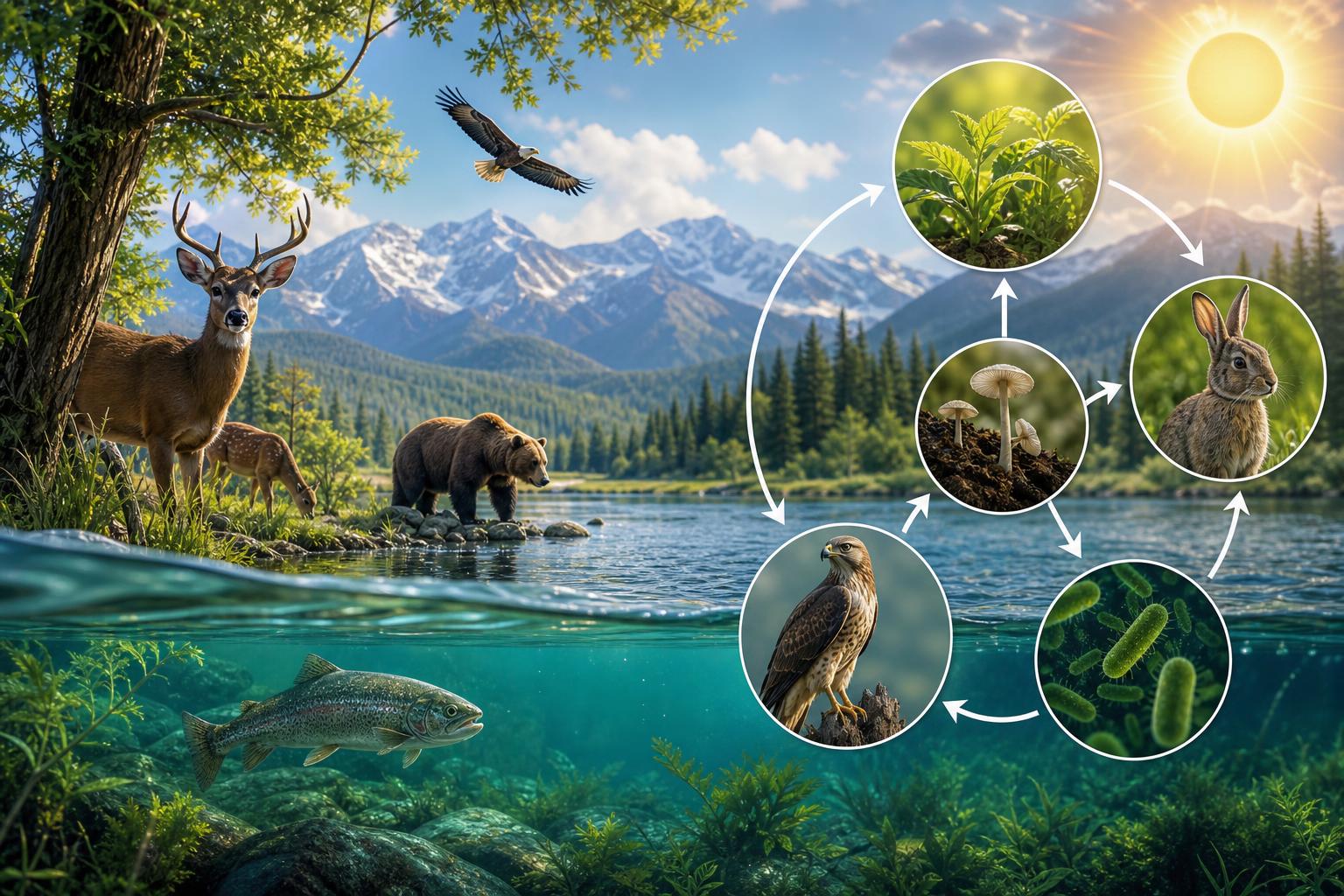
Energy enters most ecosystems through sunlight. Producers, also called autotrophs, use photosynthesis to convert light energy into chemical energy stored in glucose. Plants, algae, and some bacteria are common producers. Consumers, or heterotrophs, get energy by eating other organisms. Primary consumers eat producers, secondary consumers eat primary consumers, and tertiary consumers eat higher-level consumers. Decomposers, such as fungi and bacteria, break down dead organisms and waste, returning nutrients to the soil or water. Energy is lost as heat at each trophic level, so only a small portion of energy is passed upward through a food chain.
Food Chains, Food Webs, and Trophic Levels
A food chain is a simple model that shows one pathway of energy transfer, such as grass to rabbit to fox. A food web is more realistic because most organisms eat and are eaten by more than one species. Each feeding position in a food chain or food web is called a trophic level. Producers occupy the first trophic level, herbivores are usually the second, and carnivores or omnivores can occupy higher levels. Ecological pyramids are diagrams that show energy, biomass, or numbers of organisms at different trophic levels. Because energy decreases at each level, ecosystems usually support fewer top predators than producers.
Nutrient Cycles in Ecosystems
Unlike energy, matter is recycled within ecosystems. The water cycle moves water through evaporation, condensation, precipitation, runoff, infiltration, and transpiration. The carbon cycle moves carbon among the atmosphere, living organisms, oceans, rocks, and fossil fuels through photosynthesis, respiration, decomposition, combustion, and sedimentation. The nitrogen cycle converts nitrogen into forms organisms can use through nitrogen fixation, nitrification, assimilation, ammonification, and denitrification. Decomposers play a major role in nutrient cycling because they break down dead matter and release nutrients back into the environment.
Species Interactions and Community Structure
Organisms in ecosystems interact in many ways. Predation occurs when one organism kills and eats another. Competition happens when organisms require the same limited resource, such as food, space, light, or mates. Mutualism is a relationship in which both species benefit, such as bees pollinating flowers while collecting nectar. Commensalism benefits one species without significantly affecting the other. Parasitism benefits one organism while harming the host. These interactions shape population sizes, community structure, and the overall balance of an ecosystem.
Ecosystem Change, Biodiversity, and Stability
Ecosystems are dynamic and can change over time. Disturbances such as fires, storms, droughts, floods, invasive species, disease, pollution, and human land use can alter ecosystem structure. Ecological succession is the gradual change in a community after a disturbance or the formation of new habitat. Primary succession begins where no soil exists, such as on bare rock after a volcanic eruption. Secondary succession occurs where soil remains, such as after a forest fire. Biodiversity generally increases ecosystem resilience because diverse communities often have more ways to maintain function after environmental change.
Flashcards
What is an ecosystem?
An ecosystem is a community of living organisms interacting with each other and with the nonliving environment in a specific area.
What are biotic factors?
Biotic factors are the living parts of an ecosystem, such as plants, animals, fungi, bacteria, and other organisms.
What are abiotic factors?
Abiotic factors are the nonliving parts of an ecosystem, such as sunlight, water, temperature, soil, minerals, and air.
What is a producer in an ecosystem?
A producer is an organism, such as a plant or algae, that makes its own food, usually through photosynthesis.
What is the difference between a food chain and a food web?
A food chain shows one path of energy transfer, while a food web shows many interconnected feeding relationships.
Why does energy decrease at higher trophic levels?
Energy decreases because organisms use energy for life processes and much of it is released as heat at each trophic level.
What do decomposers do?
Decomposers break down dead organisms and waste, recycling nutrients back into the ecosystem.
What is biodiversity?
Biodiversity is the variety of life in an area, including the variety of species, genes, and ecosystems.
What is ecological succession?
Ecological succession is the gradual change in the species and structure of a community over time.
What is a trophic level?
A trophic level is a feeding position in a food chain or food web, such as producer, primary consumer, or secondary consumer.
Quiz
1. Which statement best defines an ecosystem?
- A. A group of organisms of one species living together
- B. All living organisms and nonliving factors interacting in an area
- C. Only the animals that live in a particular habitat
- D. A single food chain in a forest
Show answer
Answer: All living organisms and nonliving factors interacting in an area
An ecosystem includes both biotic factors, such as organisms, and abiotic factors, such as water, sunlight, soil, and climate.
2. Which organism is most likely a producer?
- A. Mushroom
- B. Grass
- C. Wolf
- D. Rabbit
Show answer
Answer: Grass
Grass is a plant that uses photosynthesis to make food, so it is a producer.
3. What usually happens to available energy as it moves up a food chain?
- A. It increases at each trophic level
- B. It stays exactly the same
- C. It decreases at each trophic level
- D. It disappears before reaching consumers
Show answer
Answer: It decreases at each trophic level
Energy is used for metabolism and released as heat, so less energy is available to organisms at higher trophic levels.
4. Which process is most directly performed by decomposers?
- A. Capturing sunlight for photosynthesis
- B. Breaking down dead matter and recycling nutrients
- C. Producing oxygen from nitrogen gas
- D. Hunting top predators
Show answer
Answer: Breaking down dead matter and recycling nutrients
Decomposers such as bacteria and fungi break down dead organisms and waste, returning nutrients to the environment.
5. Which example shows mutualism?
- A. A lion hunting a zebra
- B. Two trees competing for sunlight
- C. A tick feeding on a dog
- D. A bee pollinating a flower while collecting nectar
Show answer
Answer: A bee pollinating a flower while collecting nectar
In mutualism, both species benefit. The bee gets food, and the flower gets help with pollination.
6. What is the main difference between primary and secondary succession?
- A. Primary succession begins without soil, while secondary succession begins where soil remains
- B. Primary succession happens only in oceans, while secondary succession happens only in deserts
- C. Primary succession is caused by animals, while secondary succession is caused by plants
- D. Primary succession is faster because mature trees are already present
Show answer
Answer: Primary succession begins without soil, while secondary succession begins where soil remains
Primary succession starts on newly exposed surfaces without soil, while secondary succession occurs after a disturbance in an area where soil is still present.
FAQs
What should I include in ecosystem notes for biology?
Good ecosystem notes should include definitions of ecosystems, biotic and abiotic factors, producers, consumers, decomposers, food chains, food webs, trophic levels, nutrient cycles, species interactions, biodiversity, and succession.
What is the easiest way to remember energy flow in ecosystems?
Remember that energy usually starts with the sun, is captured by producers, moves to consumers, and eventually reaches decomposers. Unlike matter, energy flows in one direction and decreases at each trophic level.
How can I study ecosystems for a quiz?
Start with an ecosystems summary, then draw a food web, label trophic levels, review nutrient cycles, and practice with ecosystem flashcards. Finish by answering quiz questions that ask you to apply concepts to real examples.
Next step
Turn this topic into a study session with notes, flashcards, and a practice quiz built from your own class material.

Leave a Reply