
Listen to this article
DNA Replication Study Guide
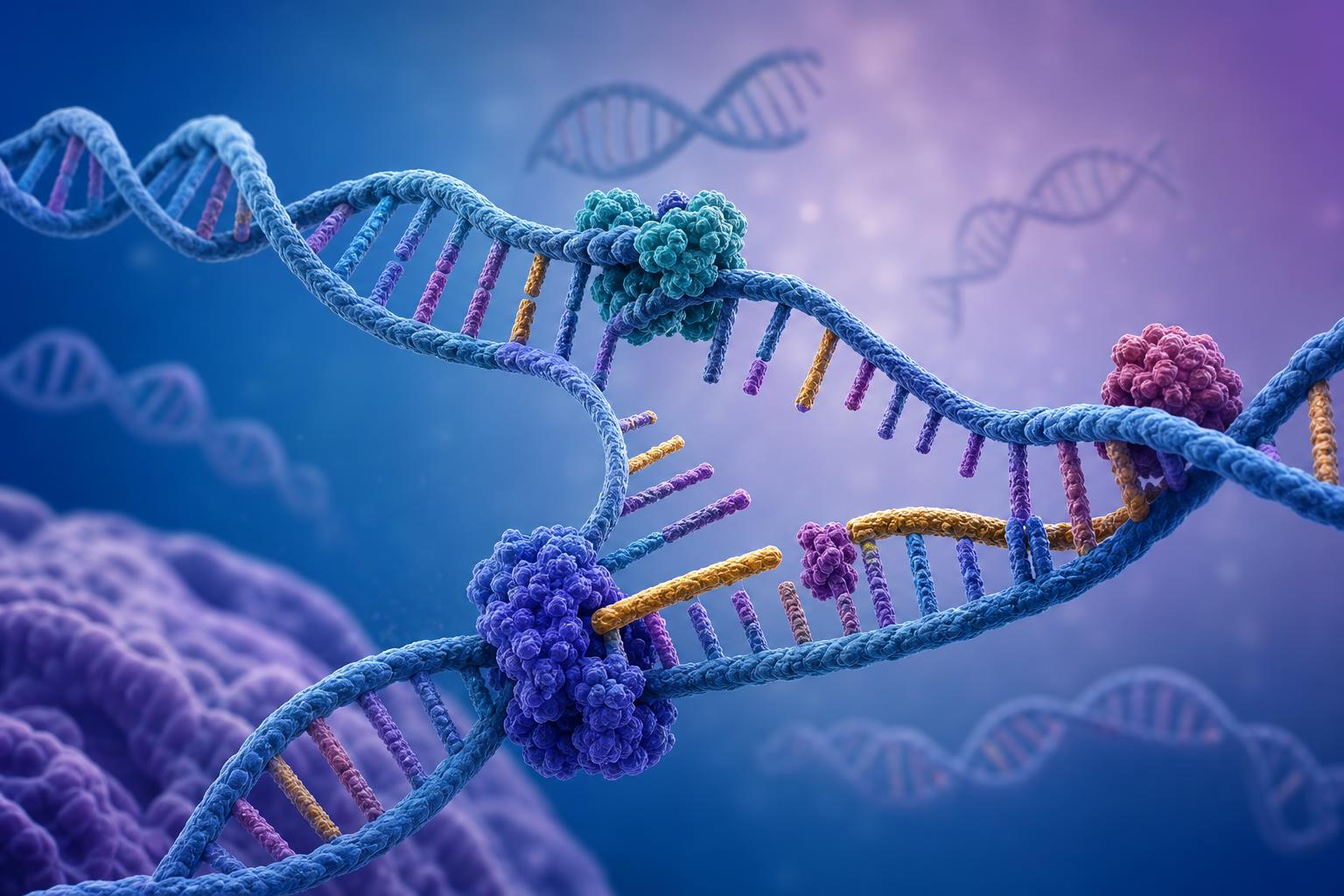
DNA replication is the biological process that copies a cell’s DNA before cell division. In this dna replication study guide, you’ll review how the double helix is unwound, how each original strand serves as a template, and how enzymes build two identical DNA molecules. This guide is designed for general biology students who need clear DNA replication notes, a useful DNA replication summary, practice flashcards, and a short quiz to check understanding.
Key takeaways
- DNA replication is semiconservative, meaning each new DNA molecule contains one original strand and one newly synthesized strand.
- Replication begins at origins of replication where the DNA double helix is opened by helicase.
- DNA polymerase builds new DNA strands by adding complementary nucleotides in the 5' to 3' direction.
- The leading strand is synthesized continuously, while the lagging strand is synthesized in short Okazaki fragments.
- Primase, helicase, DNA polymerase, ligase, and topoisomerase are key enzymes involved in DNA replication.
DNA Replication Summary
DNA replication is the process cells use to make an accurate copy of their DNA. It happens before cell division so each daughter cell receives a complete set of genetic instructions. The process is called semiconservative because each newly formed DNA molecule contains one old parental strand and one new complementary strand. The sequence of bases on each original strand determines the sequence of bases on the new strand through base-pairing rules: adenine pairs with thymine, and cytosine pairs with guanine.
Where DNA Replication Begins
Replication begins at specific DNA sequences called origins of replication. In prokaryotes, there is usually one circular chromosome with a single origin. In eukaryotes, chromosomes are longer and linear, so they have many origins of replication. At each origin, the DNA opens to form a replication bubble. The Y-shaped regions where DNA is actively being copied are called replication forks. Replication moves outward from the origin as enzymes separate the strands and build new DNA.
Key Enzymes in DNA Replication
Several enzymes work together during DNA replication. Helicase unwinds and separates the two DNA strands by breaking hydrogen bonds between base pairs. Topoisomerase relieves tension ahead of the replication fork so the DNA does not become overwound. Single-strand binding proteins help keep the separated strands apart. Primase makes short RNA primers that provide a starting point for DNA synthesis. DNA polymerase adds DNA nucleotides to the growing strand and proofreads for errors. DNA ligase seals gaps between DNA fragments, especially on the lagging strand.
Leading Strand and Lagging Strand
DNA polymerase can only add nucleotides to the 3' end of a growing strand, so new DNA is always synthesized in the 5' to 3' direction. Because the two original DNA strands run in opposite directions, replication occurs differently on each strand. The leading strand is made continuously toward the replication fork. The lagging strand is made discontinuously away from the fork in short pieces called Okazaki fragments. DNA ligase later joins these fragments into one continuous strand.
Accuracy and Proofreading
DNA replication is highly accurate because DNA polymerase checks newly added nucleotides and removes many mistakes. This proofreading function helps prevent mutations. Even with proofreading, some errors can remain, and cells have additional DNA repair mechanisms to correct damage or mismatched bases. Accurate DNA replication is essential because errors in genetic information can affect proteins, traits, and cell function.
Flashcards
What is DNA replication?
DNA replication is the process by which a cell copies its DNA before cell division.
Why is DNA replication described as semiconservative?
It is semiconservative because each new DNA molecule contains one original parental strand and one newly synthesized strand.
Which enzyme unwinds the DNA double helix?
Helicase unwinds the DNA double helix by breaking hydrogen bonds between base pairs.
What does DNA polymerase do during replication?
DNA polymerase adds complementary DNA nucleotides to a growing strand and helps proofread errors.
What are Okazaki fragments?
Okazaki fragments are short DNA segments made on the lagging strand during DNA replication.
What enzyme joins Okazaki fragments together?
DNA ligase joins Okazaki fragments by sealing gaps in the sugar-phosphate backbone.
In which direction does DNA polymerase synthesize new DNA?
DNA polymerase synthesizes new DNA in the 5' to 3' direction.
Quiz
1. What does semiconservative replication mean?
- A. Each new DNA molecule has two newly made strands
- B. Each new DNA molecule has one old strand and one new strand
- C. DNA is copied without separating the strands
- D. RNA is used as the final genetic material
Show answer
Answer: Each new DNA molecule has one old strand and one new strand
Semiconservative replication means each daughter DNA molecule preserves one parental strand and includes one newly synthesized strand.
2. Which enzyme separates the two DNA strands at the replication fork?
- A. DNA ligase
- B. Primase
- C. Helicase
- D. Ribosome
Show answer
Answer: Helicase
Helicase breaks hydrogen bonds between base pairs, allowing the DNA strands to separate for copying.
3. Why is the lagging strand made in fragments?
- A. DNA polymerase can only synthesize DNA in the 5' to 3' direction
- B. The lagging strand has no bases
- C. RNA polymerase destroys it
- D. DNA ligase prevents continuous synthesis
Show answer
Answer: DNA polymerase can only synthesize DNA in the 5' to 3' direction
Because DNA strands are antiparallel and DNA polymerase works only 5' to 3', the lagging strand must be made in short Okazaki fragments.
4. What is the role of primase in DNA replication?
- A. It joins Okazaki fragments
- B. It creates RNA primers
- C. It unwinds the DNA helix
- D. It removes all mutations
Show answer
Answer: It creates RNA primers
Primase makes short RNA primers that give DNA polymerase a starting point for adding nucleotides.
5. Which enzyme seals gaps between DNA fragments on the lagging strand?
- A. Helicase
- B. Topoisomerase
- C. DNA ligase
- D. Primase
Show answer
Answer: DNA ligase
DNA ligase forms bonds in the sugar-phosphate backbone, joining Okazaki fragments into a continuous strand.
6. Where does DNA replication begin?
- A. At origins of replication
- B. At ribosomes
- C. At the cell membrane
- D. At amino acids
Show answer
Answer: At origins of replication
Replication begins at specific DNA sequences called origins of replication, where the double helix opens.
FAQs
When does DNA replication occur?
DNA replication occurs before cell division, during the S phase of interphase in eukaryotic cells. This ensures each daughter cell receives a complete copy of the genome.
What is the difference between the leading and lagging strands?
The leading strand is synthesized continuously toward the replication fork. The lagging strand is synthesized discontinuously in Okazaki fragments because DNA polymerase can only add nucleotides in the 5' to 3' direction.
Why is DNA replication important?
DNA replication is important because it passes genetic information from one cell generation to the next. Without accurate replication, daughter cells would not receive the correct instructions for growth, function, and survival.
Next step
Turn this topic into a study session with notes, flashcards, and a practice quiz built from your own class material.

Leave a Reply