
Listen to this article
Natural Selection Study Guide
Natural selection is one of the main mechanisms of evolution. It explains how populations change over generations when individuals with helpful inherited traits survive and reproduce more successfully than others in the same environment. This natural selection study guide reviews the core ideas, key vocabulary, classic examples, and common misconceptions so you can turn your biology notes into a stronger evolution summary and prepare for quizzes or exams.
Key takeaways
- Natural selection acts on individuals, but evolution occurs in populations over generations.
- For natural selection to occur, there must be variation, heritability, competition or differential survival, and differential reproduction.
- Adaptations are inherited traits that increase an organism’s fitness in a specific environment.
- Natural selection does not create traits on purpose; it favors existing heritable variations that improve survival or reproduction.
- Environmental conditions determine which traits are advantageous, so a trait that helps in one environment may not help in another.
What Is Natural Selection?
Natural selection is the process by which organisms with advantageous inherited traits tend to survive and reproduce more successfully than organisms without those traits. Over time, the helpful traits become more common in the population. Natural selection is a major mechanism of evolution, which means it contributes to changes in the genetic makeup of populations across generations. Charles Darwin and Alfred Russel Wallace independently developed the idea, and Darwin later explained it in detail in On the Origin of Species.
The Conditions Required for Natural Selection
Natural selection depends on several conditions. First, individuals in a population must vary in their traits, such as size, color, resistance to disease, or behavior. Second, at least some of that variation must be heritable, meaning it can be passed from parents to offspring through genes. Third, more individuals are often born than can survive, creating competition for resources such as food, space, mates, or shelter. Finally, individuals with certain traits must have higher fitness, meaning they leave more surviving offspring than others. When these conditions are met, allele frequencies in the population can change over time.
Fitness, Adaptations, and Environment
In biology, fitness does not simply mean physical strength. Fitness means reproductive success: how well an organism passes its genes to the next generation. An adaptation is an inherited trait that increases fitness in a particular environment. For example, camouflage can help prey avoid predators, and antibiotic resistance can help bacteria survive exposure to a drug. However, adaptations are environment-specific. Thick fur may be beneficial in a cold habitat but harmful in a hot one. Natural selection depends on the relationship between traits and environmental pressures.
Types of Natural Selection
Biologists often describe natural selection in three common patterns. Directional selection favors one extreme form of a trait, such as bacteria becoming more resistant to antibiotics. Stabilizing selection favors intermediate traits and reduces extremes, such as human birth weight where very low and very high weights can be risky. Disruptive selection favors both extremes over the average, which can sometimes contribute to the formation of distinct groups within a population. These patterns help explain how trait distributions shift in populations.
Examples of Natural Selection
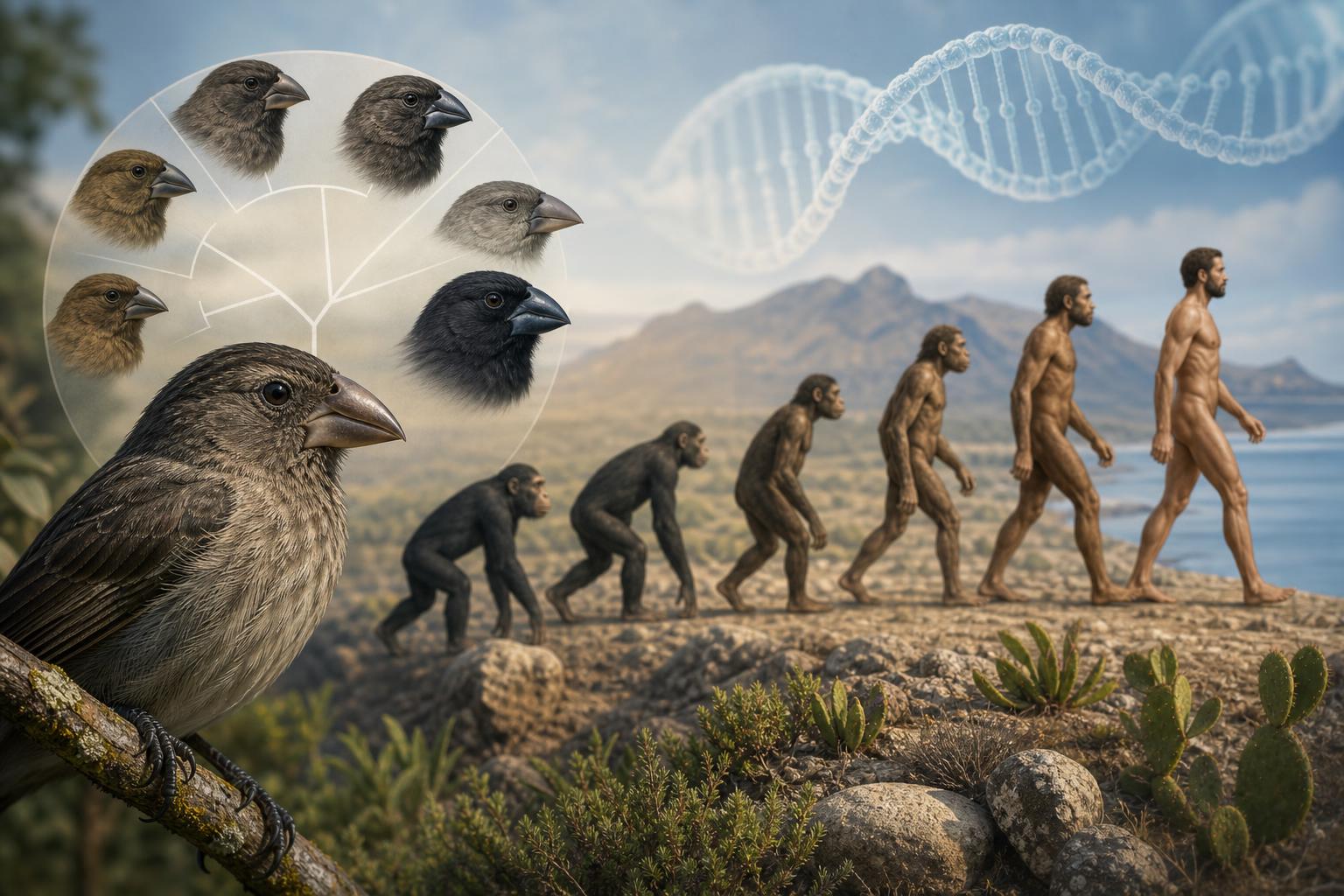
A classic example is the peppered moth in England. During the Industrial Revolution, soot darkened tree bark, making dark moths less visible to predators and light moths more vulnerable. As a result, dark moths became more common in polluted areas. Another example is Darwin’s finches, whose beak shapes vary depending on available food sources. During droughts, finches with beaks better suited to available seeds may survive and reproduce more successfully. Antibiotic resistance in bacteria is also a modern example: resistant bacteria survive treatment and pass resistance genes to future generations.
Common Misconceptions About Natural Selection
Natural selection is not a random process, although mutations that create variation can occur randomly. It also does not make organisms perfect. Selection can only work with existing variation, and traits often involve trade-offs. Natural selection does not happen because organisms try to change or because they need a trait. Instead, individuals with traits that already improve survival or reproduction in a given environment are more likely to pass those traits on. Also, individuals do not evolve during their lifetimes; populations evolve over generations.
Flashcards
What is natural selection?
Natural selection is the process in which individuals with advantageous inherited traits survive and reproduce more successfully, causing those traits to become more common in a population over generations.
What is fitness in evolutionary biology?
Fitness is an organism’s reproductive success, measured by how effectively it passes its genes to the next generation.
What four conditions are needed for natural selection?
Natural selection requires variation, heritability, competition or environmental pressure, and differential survival and reproduction.
Does natural selection act on individuals or populations?
Natural selection acts on individuals, but evolutionary change occurs in populations over generations.
What is an adaptation?
An adaptation is an inherited trait that increases an organism’s fitness in a specific environment.
Why is antibiotic resistance an example of natural selection?
Bacteria with resistance genes survive antibiotic treatment and reproduce, making resistance more common in the bacterial population.
What is directional selection?
Directional selection occurs when one extreme form of a trait is favored, shifting the population toward that extreme over time.
Quiz
1. Which statement best defines natural selection?
- A. A process in which inherited traits that improve survival or reproduction become more common
- B. A process in which individuals choose to develop traits they need
- C. A process in which all organisms become stronger over time
- D. A process in which acquired traits are automatically passed to offspring
Show answer
Answer: A process in which inherited traits that improve survival or reproduction become more common
Natural selection favors heritable traits that increase fitness, so those traits tend to become more frequent in a population over generations.
2. What does fitness mean in evolutionary biology?
- A. Physical strength
- B. Reproductive success
- C. The ability to change during life
- D. The age of an organism
Show answer
Answer: Reproductive success
Fitness refers to how successfully an organism passes its genes to future generations, not simply how strong or healthy it appears.
3. Which condition is necessary for natural selection to occur?
- A. All individuals must be genetically identical
- B. Traits must be heritable
- C. The environment must never change
- D. Organisms must intentionally adapt
Show answer
Answer: Traits must be heritable
Natural selection can only change populations over generations when beneficial traits can be inherited by offspring.
4. In the peppered moth example, why did dark moths become more common in polluted areas?
- A. Dark moths were harder for predators to see on soot-darkened trees
- B. Dark moths learned to avoid pollution
- C. Light moths changed into dark moths during their lives
- D. Pollution directly created dark moths from tree bark
Show answer
Answer: Dark moths were harder for predators to see on soot-darkened trees
Dark coloration provided better camouflage on polluted tree bark, improving survival and reproduction for dark moths.
5. Which type of selection favors average traits and selects against extreme traits?
- A. Directional selection
- B. Stabilizing selection
- C. Disruptive selection
- D. Artificial selection
Show answer
Answer: Stabilizing selection
Stabilizing selection favors intermediate forms of a trait and reduces the frequency of extreme forms.
6. Which statement is a common misconception about natural selection?
- A. Natural selection works with existing heritable variation
- B. Individuals evolve during their own lifetimes
- C. Populations can change over generations
- D. Environmental pressures can affect which traits are favored
Show answer
Answer: Individuals evolve during their own lifetimes
Individuals may develop or change during life, but evolution refers to genetic changes in populations across generations.
FAQs
How is natural selection different from evolution?
Evolution is the change in the genetic makeup of a population over generations. Natural selection is one mechanism that causes evolution by favoring inherited traits that improve survival or reproduction in a particular environment.
Is natural selection random?
Natural selection itself is not random because certain traits are favored based on environmental conditions. However, the genetic variation that selection acts on can arise through random mutations and recombination.
Can natural selection produce perfect organisms?
No. Natural selection works with existing variation and is limited by genetics, trade-offs, environmental changes, and historical constraints. It can produce useful adaptations, but not perfect organisms.
Next step
Turn this topic into a study session with notes, flashcards, and a practice quiz built from your own class material.

Leave a Reply