
Listen to this article
Osmosis and Diffusion Study Guide
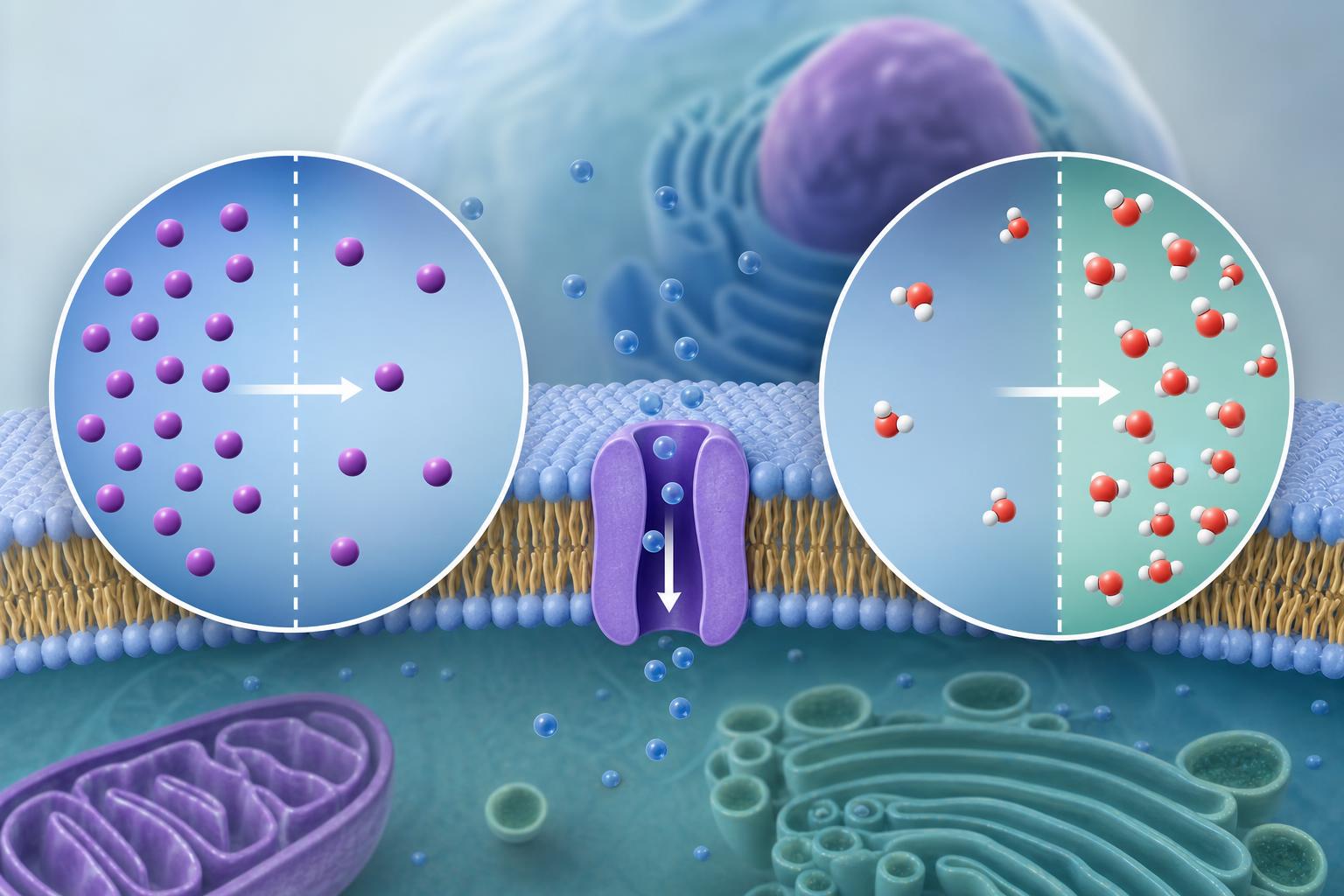
Osmosis and diffusion are two essential passive transport processes that help substances move in and around cells without using cellular energy. Diffusion describes the movement of particles from an area of higher concentration to an area of lower concentration, while osmosis is the diffusion of water across a selectively permeable membrane. This osmosis and diffusion study guide explains the key vocabulary, compares the processes, and gives you practice materials to prepare for biology quizzes and exams.
Key takeaways
- Diffusion is the movement of particles from high concentration to low concentration until equilibrium is reached.
- Osmosis is a specific type of diffusion involving water moving across a selectively permeable membrane.
- Both osmosis and diffusion are passive transport processes, meaning they do not require ATP energy from the cell.
- Concentration gradients drive diffusion and osmosis; particles or water move down the gradient.
- Hypertonic, hypotonic, and isotonic solutions describe how solute concentration affects water movement in cells.
- Facilitated diffusion uses transport proteins to move substances across the cell membrane without energy.
What Is Diffusion?
Diffusion is the net movement of molecules or particles from an area where they are more concentrated to an area where they are less concentrated. This movement happens because particles are constantly in motion. Over time, they spread out evenly if there is no barrier preventing them from doing so. A common diffusion summary is: particles move down their concentration gradient until equilibrium is reached. In biology, examples include oxygen diffusing from the lungs into the blood and carbon dioxide diffusing from body cells into the bloodstream.
What Is Osmosis?
Osmosis is the diffusion of water across a selectively permeable membrane. A selectively permeable membrane allows some substances to pass through while blocking others. In cells, the plasma membrane controls what enters and leaves. During osmosis, water moves from the side with lower solute concentration and higher water concentration to the side with higher solute concentration and lower water concentration. Osmosis is especially important for maintaining cell shape, water balance, and proper cell function.
Comparing Osmosis and Diffusion
Osmosis and diffusion are related, but they are not identical. Diffusion can involve many types of particles, such as gases, ions, or small molecules. Osmosis only refers to the movement of water. Diffusion does not always require a membrane, but osmosis requires a selectively permeable membrane. Both processes are passive, so the cell does not spend ATP to make them happen. Strong osmosis notes should emphasize that osmosis is a type of diffusion, but diffusion is a broader process.
Hypertonic, Hypotonic, and Isotonic Solutions
Water movement during osmosis depends on the solute concentration around the cell. In a hypertonic solution, the fluid outside the cell has a higher solute concentration than the inside, so water leaves the cell and the cell may shrink. In a hypotonic solution, the outside fluid has a lower solute concentration than the inside, so water enters the cell and the cell may swell. In an isotonic solution, solute concentrations are balanced, so water moves in and out at equal rates and the cell stays about the same size.
Facilitated Diffusion and Membrane Transport
Some substances cannot easily pass through the phospholipid bilayer of the cell membrane. Large polar molecules and charged ions often need help from membrane proteins. Facilitated diffusion is a passive transport process in which molecules move down their concentration gradient through channel proteins or carrier proteins. For example, glucose may enter cells by facilitated diffusion using a transport protein. Like simple diffusion and osmosis, facilitated diffusion does not require ATP.
Why Osmosis and Diffusion Matter in Biology
Osmosis and diffusion help cells maintain homeostasis. They allow nutrients, gases, and waste products to move efficiently. Oxygen diffuses into cells for cellular respiration, while carbon dioxide diffuses out as a waste product. Osmosis helps regulate the water content of cells, which is especially important in plant cells, animal cells, and single-celled organisms living in watery environments. Understanding these processes is also useful for topics like kidney function, blood cells, plant wilting, and IV fluid concentration.
Flashcards
What is diffusion?
Diffusion is the movement of particles from an area of higher concentration to an area of lower concentration.
What is osmosis?
Osmosis is the diffusion of water across a selectively permeable membrane.
Do osmosis and diffusion require ATP?
No. Both are passive transport processes and do not require ATP.
What is a concentration gradient?
A concentration gradient is a difference in concentration between two areas.
What happens to an animal cell in a hypertonic solution?
Water leaves the cell, causing it to shrink.
What happens to an animal cell in a hypotonic solution?
Water enters the cell, causing it to swell and possibly burst.
What is an isotonic solution?
An isotonic solution has the same solute concentration as the cell, so water moves in and out at equal rates.
What is facilitated diffusion?
Facilitated diffusion is passive transport through membrane proteins down a concentration gradient.
Quiz
1. Which statement best defines diffusion?
- A. Movement of particles from high concentration to low concentration
- B. Movement of water from low solute concentration to high solute concentration
- C. Movement of particles using ATP
- D. Movement of proteins into the nucleus
Show answer
Answer: Movement of particles from high concentration to low concentration
Diffusion moves particles down their concentration gradient, from higher concentration to lower concentration.
2. What makes osmosis different from diffusion in general?
- A. Osmosis requires ATP
- B. Osmosis only involves water moving across a selectively permeable membrane
- C. Osmosis only occurs in plant cells
- D. Osmosis moves particles from low concentration to high concentration
Show answer
Answer: Osmosis only involves water moving across a selectively permeable membrane
Osmosis is a specific type of diffusion involving water and a selectively permeable membrane.
3. A red blood cell placed in a hypertonic solution will most likely do what?
- A. Swell because water enters the cell
- B. Shrink because water leaves the cell
- C. Stay exactly the same with no water movement
- D. Produce ATP to pump water inward
Show answer
Answer: Shrink because water leaves the cell
In a hypertonic solution, the outside has more solute, so water moves out of the cell by osmosis.
4. Which process uses channel or carrier proteins but does not require ATP?
- A. Simple diffusion
- B. Facilitated diffusion
- C. Active transport
- D. Endocytosis
Show answer
Answer: Facilitated diffusion
Facilitated diffusion moves substances down their concentration gradient through membrane proteins without energy use.
5. What does equilibrium mean in diffusion?
- A. Particles stop moving completely
- B. Particles are evenly distributed, but still move randomly
- C. Particles move only into the cell
- D. Water leaves the cell faster than it enters
Show answer
Answer: Particles are evenly distributed, but still move randomly
At equilibrium, there is no net movement in one direction, but particles continue to move randomly.
6. In a hypotonic solution, what usually happens to an animal cell?
- A. Water enters the cell and it swells
- B. Water leaves the cell and it shrinks
- C. No water crosses the membrane
- D. Solute leaves the cell using ATP
Show answer
Answer: Water enters the cell and it swells
A hypotonic solution has lower solute concentration outside the cell, so water moves into the cell.
FAQs
Are osmosis and diffusion the same thing?
They are related but not the same. Diffusion is the general movement of particles from high concentration to low concentration. Osmosis is a specific type of diffusion involving water moving across a selectively permeable membrane.
Why are osmosis and diffusion considered passive transport?
They are passive because they do not require the cell to use ATP. The movement happens naturally because of concentration differences.
What is the easiest way to remember hypertonic and hypotonic solutions?
Remember that water moves toward the area with more solute. In a hypertonic solution, water leaves the cell. In a hypotonic solution, water enters the cell.
Next step
Turn this topic into a study session with notes, flashcards, and a practice quiz built from your own class material.

Leave a Reply